Visual artist Ana Torfs was born in Belgium in 1963. The relation/tension between text and image plays a central role in Torfs’ work, and with it all the related processes of visualisation and translation, such as perception, interpretation, projection, deception, resonance, encryption, and manipulation. Existing texts are often used as a starting point, for example the conversation books of a famous composer turned deaf in ‘Zyklus von Kleinigkeiten’ (Cycle of Trifles, 1998), the records of a trial in ‘Du mentir-faux’ (About Lying Falsehood, 2000) or in ‘Anatomy’ (2006), a play by Maurice Maeterlinck in ‘The Intruder’ (2004), the dialogues of Roberto Rossellini's film 'Viaggio in Italia' in ‘Displacement’ (2009), etc. The media that serve to convey these subjects are multifaceted reproductive techniques, ranging from slide installation, film, video and photographic series to xerography and silkscreen. The slide installation occupies a prominent position among them: the alternating sequences of images lend the static photographic image some of the dynamism of the moving image and the immersive power of the cinematic screen.
Solo shows of Torfs’ work include exhibitions at Generali Foundation in Vienna (2010), at K21 Kunstsammlung Nordrhein-Westfalen in Düsseldorf (2010), at Sprengel Museum in Hannover (2008), at argos centre for art and media in Brussels (2007), at daadgalerie, Berlin (2006), at Gesellschaft für Aktuelle Kunst in Bremen (2006), and at Palais des Beaux-Arts in Brussels (2000). She has also developed a web project for Dia Art Foundation in New York (2004).
Ana Torfs studied communication science at the University of Leuven (1981-1986) and film & video at the Sint-Lukas University College of Art and Design in Brussels (1986-1990). She lives and works in Brussels.


awards, residencies, education, etc.

2011
Cera Partners in Art
Cité des Arts
Paris (FR)

2007
Production-in-residence, Baltic Art Center
Visby (SE)

2005/2006
Artists-in-Residency Program
DAAD, Berlin (DE)

2004
Prix de Recherche Michèle Fabien
SACD, Brussels (BE)
Cultural Award for Visual Arts
Flemish Authorities (BE)

1999
Grand Prix
International Festival of New Film, Split (HR)

1995
Prix du Jeune Créateur, 5th International Video Week
Centre pour l’Image Contemporaine Saint-Gervais, Geneva (CH)

1992
Lauréat de la Promotion François Vaxelaire
Fondation belge de la vocation, Brussels (BE)

1986-1990
Master’s Degree: Film & Video
Sint-Lukas University College of Art & Design, Brussels (BE)

1981-1986
Master’s Degree: Communication Science
K.U. Leuven University, Leuven (BE)


work in public collections

K21, Kunstsammlung Nordrhein-Westfalen
FRAC Lorraine, Metz
Generali Foundation, Vienna
MuHKA, Antwerp
Collection of the Flemish Authorities, Brussels


links

BAM
kunstonline


mail@anatorfs.com

Ana Torfs would like to thank everyone who has been involved and all those who have supported her work.

The site www.anatorfs.com is protected by copyright.
All unauthorised reproduction is strictly forbidden.

© the artist, the authors, the translators and the photographers
© all photographs Ana Torfs unless stated otherwise
© the designers of this website www.nnbxl.com & www.wetnet.com

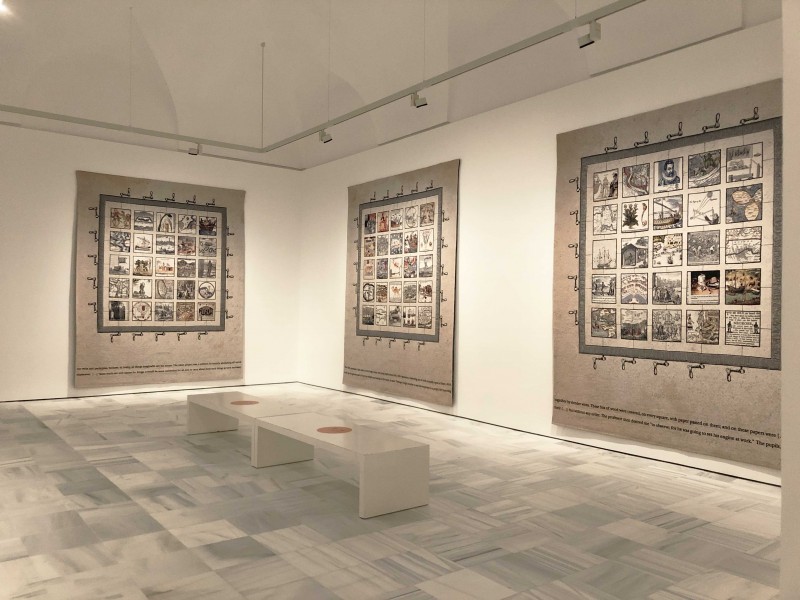
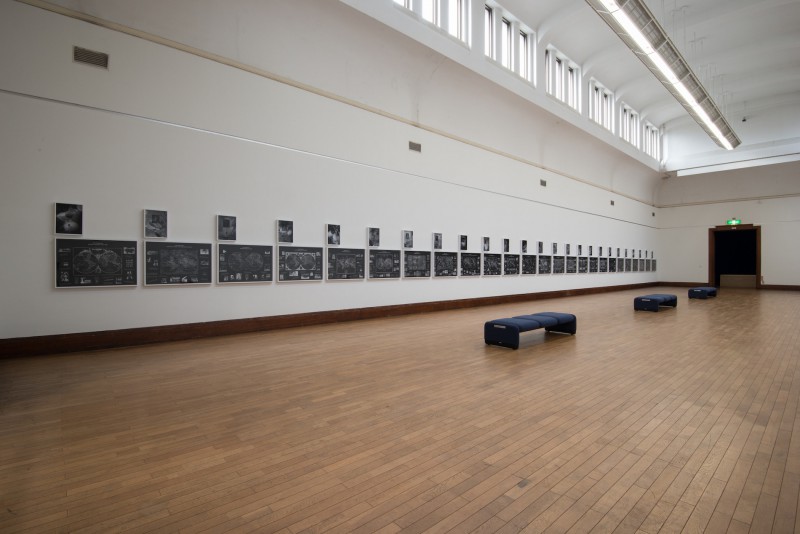
FAMILY PLOT #1 & #2 (2009/2010) :: text images

installation, 25 digital prints on aluminium, framed each 70 x 100 cm; 25 lambda prints on aluminium and silkscreen on glass, framed each 44,5 x 32,5 cm, total dimensions variable

Although Ana Torfs had been fascinated by botany, gardens, and horticulture for quite a long time, she first became involved with the classification system for nature with “Family Plot #1” and “Family Plot #2” beginning in 2008. The impulse came from the Swedish “father of modern taxonomy,” Carl Linnaeus (1707–1778), whom she stumbled upon during her artist-in-residency stay on Gotland in 2007. Linnaeus had explored this island in the Baltic Sea for medical plants, textile dyes, as well as useful raw materials beginning in 1741, under commission by the Swedish parliament. In addition to Linnaeus’ literary talent expressed in his travelogue about Öland and Gotland, his binomial naming system captured Torfs’ sustained interest.

On the basis of selected botanical genera, the photographic series “Family Plot #1”, 2009, refers explicitly to the nomenclature that Linnaeus introduced and the “naming history” behind it. Prior to Linnaeus, many naturalists gave individual, arbitrarily amendable (Latin) names to the species that they studied and described. The great number of plants that were introduced into Europe via naval expeditions to Africa, Asia, and the Americas, made a more practical naming system indispensible. Linnaeus was certainly not the first naturalist to use double names. Nonetheless, he was the first to employ them consistently: following the model of a given name and surname, Linnaeus propagated the systematic use of a two-part Latin genus name with only one specific surname, the species name. Also included in the full name is the initial of the name-giving author. “L.” stands for Linnaeus: for example, in the name Homo sapiens L., which he published in 1758.

Linnaeus’ naming system, although only a chance byproduct of his enormous encyclopedic efforts to identify and register genera and species concisely and precisely, is nonetheless his most influential contribution and remains the standard today. Linnaeus also consciously subdivided the species based on artificially selected traits in order to create a classification system that is easy to use and learn. However, this system ignored, for the most part, natural relationships among the species. As a student Linnaeus had dealt with the then new idea of the sexuality of plants, and later concentrated on the description of stamens (masculine) and pistil (female reproductive organs). Rather than including the entire plant and its construction in his taxonomy, he divided all plants based on these characteristics (their number, form, proportion, and situation) into 24 corresponding groups, classes, and orders. This method led to a controversial debate and the accusation of botanical pornography. Contemporaries countered his concept that nature could be classified systematically, claiming that it was too diverse and versatile to adapt to such a strict framework. In his standard work “The Order of Things”, Michel Foucault later included Linnaeus’ method of classification as part of the natural science tradition of observing, which means being content with seeing, and seeing a few things systematically. Linnaeus was especially concerned with dismissing “obscure similitudes” of things in the world. (1)

Linnaeus’ nomenclature—which in addition to specific characteristics such as color, size, behavior, and the location of discovery, also derived the names of the genera and species group from people—accompanied Europe’s global expansion and colonization in the seventeenth and eighteenth centuries. Many of the “newly” discovered plants throughout the world were thus named after their—usually white, Western—discoverers, their commissioners, regents, or sponsors, or were dedicated to important personalities. Among other things, the existing indigenous names were ignored. This, and much else makes evident that naming is always an act of appropriation, which poses questions of identity that determine the course of (hi)stories. But this is only one aspect resonating in Torfs’ title, “Family Plot”. The word “plot” can mean the plot of a story, an intrigue, a piece of land, a ground plan, or a graphic representation such as a chart. As always in Torfs’ work, following the hints contained in the meaning of the title opens essential aspects of the concept. Torfs’ aesthetic analysis of Linnaeus’ efforts at a uniform classification scheme and the associated politics of naming focuses, for one, on the network of this linguistic imperium. “Family Plot #1” thus presents an imaginary community of Western elites. Other influential personalities followed Linnaeus, for example, Joseph Banks, President of the British Royal Society, who propagated the binomial system. Solandra grandiflora Sw. is Swedish botanist Olof Swartz’ homage to Linnaeus’ student Daniel Carlsson Solander who went to London in 1760 and introduced his teacher’s classification and naming system in England. In the late nineteenth century, German botanist Hermann Wendland honored the first president of the United States, George Washington, with the nomenclature Washingtonia robusta Wendl.

Torfs’ title “Family Plot”, also subliminally touches upon connotations of a “complot.” Without wagging a finger, she presents the reverse side of a family context, namely, the authority carried by naming and the establishment of those who belong and those who are excluded in rational-hegemonic systems, in this case, the purportedly objective system of botany. In his “Systema Naturae”(1758), Linnaeus transferred his classification system to humans, whom he first placed in the group with apes. His differentiation of humans analogous to continents most definitely stimulated later racist views. No least because he assigned each of the four types a skin color, a temperament, and a posture. He characterized Homo Americanus as red, choleric, and combative; Homo Africanus as black, cunning and negligent; Homo Asiaticus as yellow, melancholic, and stingy; Homo Europaeus, on the contrary, as white, sanguine and inventive, inclined toward tight clothing, and governed by law. Attentive readers can find this out from one of the speech bubbles on Linnaeus’ world panel in “Family Plot #2”.

Similar to a family tree, “Family Plot #1” presents alongside Linnaeus, 24 photographically reproduced historical portraits of name patrons, and set smaller to each of these, the name of the botanist who gave the name including a diagram of the nomenclature process. Torfs positioned this “documentation” under a black-and-white silkscreen of the plant or fruit on glass. For this reason, our gaze oscillates between a confrontation with the tradition of the portrait as an expression of power, recognition, or importance, and the poetically diaphanous stylized beauty of nature. The close-ups of the reproductive units not only refer to Linnaeus’ sexual categories, but obviously also explore the eroticism of the plants. The charisma of the photos lies subtly between a finely detailed closeness and sharpness of Karl Blossfeldt and the greatly enlarged, nearly abstract flower photos by Georgia O’Keeffe. The fact that there were almost no women among the name patrons is symptomatic for historical social relations and leads the idea of the traditional family tree ad absurdum—whereby, in addition, almost all of the plants depicted are hermaphroditic and polygamous.

Although Torfs’ starting point was her linguistic interest in plant names, and not initially the explorers and their stories, she was fascinated by these biographies from an era in which the order of things at a small as well as large scale was being systematized along enlightenment ideas. Using the plants as a starting point, she became intensely occupied with the era of discovery, research expeditions, and conquests; the details slumbering within, and the connections of the famous names and adventures documented by the names of the plants. (2) She thus explored the cosmos of scientific-political elite of the fifteenth to nineteenth centuries and one year later produced a second, supplementary series of display boards, “Family Plot #2”, (2010). Rather than portrait photographs (albeit superimposed ones), she now sketched out the worlds of the naming explorers, led by the questions: how and under what ideological postulates was knowledge formed back then? Starting with the 25 reproductions of plants and portraits from “Family Plot #1”, she pursues the history of global exploration and colonization in great detail, based on various finds.

On every print, the header “THE WORLD OF...” indicates not only each of the known or interesting land masses, represented centrally and dominating the image with the help of marvelous, then-contemporary world maps, but also aims at the connections and mutual relations of the contexts via reproduced illustrations and documents from archives and encyclopedias. Here, along with the extremely diverse charts, Torfs also collects book covers from travelogues and scientific literature, and, for example, plant depictions and other engravings, such as that of the first representation of alleged North American “Indians.” Such representations shaped Europe’s view of the rest of the world. Invention of the printing press enabled a high-circulation exchange of information. For this reason, in her selection of images, Torfs reproduces only historical woodcuts and engravings. This is a reference to the beginnings of the era of individual reading and study.

We can travel to Japan with Carl Peter Thunberg, to China with Jean Pierre Armand David, and we can explore Australia with Joseph Banks, Daniel Carlsson Solander, and John Macadam. Quassie van Timotibo, the only non-white explorer in the series, who as a child was brought to Surinam as an African slave, and naturally, Alexander von Humboldt, guide our view towards South America, and George Washington towards North America. Among them are also a few sovereigns, such as Spanish rulers Carlos IV and Maria Luisa de Borbón- Parma who reigned over a large part of South and North America and Spanish East India including their natural and mineral resources, or Sophia Charlotte Mecklenburg-Strelitz, who as queen Charlotte at the side of George III, not only delighted at the flowers of the Royal Botanic Gardens in Kew, but also received petitions against slavery directly addressed to her. In these universes, Torfs’ text bubbles arrange biographical building blocks and historical sources, which are provided with no additional identification. Anonymous quotes of world knowledge. Also: mainly “official” sources rather than personal memories are used in order to introduce “THE WORLD OF… ”. Yet central to each are contemporary world maps, which the pictures and word clouds circle around. Torfs hereby presents in this extremely condensed form more than just an outline of the various mental maps. She traces the careers of the name givers, their discoveries, ideas, and ideologies almost in the sense of mentality history as inevitably shaped cultural stories—shaped, namely, by colonization, exploitation, and slavery. In this context, cartography as well as name giving imply authoritative appropriation. Torfs explores history as a series of personal worlds, shows it as entirely individually and subjectively experienced, and as something told—and indeed, by anonymous narrators. Regardless of the interests and goals they have, those who speak are not made explicit. Apparently, once again, subjectivity is at issue here, and problematizing it.

“Family Plot #2” intensifies the focus on each of the figures, which means that this series functions only as part of the installation and not as an independent work. While in “Family Plot #1” Torfs chose people who were central in the history of naming exotic plants, in “Family Plot #2” she shows their astounding enmeshment within political and economic lobbies. As in “Family Plot #1”, Linnaeus is the center and starting point of this family archeology. As in his own system of classification, Torfs chooses 24 further plants and thereby people who are related to him in one way or another. She arranges them looking toward him, in the middle. Her arrangement follows the alphabet and has the courage to reveal gaps. She begins with French botanist Michel Adanson (1727–1806), who additionally used the plants’ indigenous names and was unsuccessful in asserting himself against Linnaeus, and ends with Friedrich Martin Josef Welwitsch (1806–1872) from Klagenfurt whom Queen Maria II sent from Portugal to Angola.

Here, too, Torfs puts the order of the names, as the encyclopedia has established them, before their chronology. It thus becomes clear only at second glance that forerunners to Linnaeus most definitely play a role in this history, such as the botanist Otto Brunfels (1488–1534) whom Linnaeus cited as a “Father of Botany,” and to whom he dedicated the genus Brunfelsia. Matthias de L’Obel (1538–1616) born in Lille, provided the first accurate description of African and American species, including tobacco. In addition, many speech balloons harbor references to Columbus whose journeys most likely provided the foundation for a Babylonian confusion of terms. The association with an ancestral gallery is thus present in more than just the size and the hanging. Beyond the reading exemplarily sketched out here is a series of images whose perfection plants a seed of doubt regarding the strict beauty of their surfaces, even for beholders whose study goes no deeper.

The broadly sweeping series astonishes through a central stylistic means that is characteristic of Torfs’ work. With an artists’ authority, Torfs sets her own system atop these cosmoses, standardizing utterly diverse materials in an intensely visual black-and-white aesthetics. She reproduces all her finds in negative. Slavery, one of the virulent thematic strands here, is a possible reference for this black metaphor. These worlds do not exude revolution or enlightenment, but instead, appear as history’s dark hours. Thus, it is not only the extensive information that prohibits an innocent enjoyment of the historical —but by no means idyllic—images from the past Torfs collected in her pictorial atlas, but also the surprisingly fascinating finding of form. Most obvious is the reverse of the printed colors in the depictions of Black people: through this technique, their skin appears white. Inversion abstracts the gathered documents and harmonizes extremely diverse sources, times, countries, languages, and dimensions. But it also suggests the association of a fluoroscopy or a blueprint, that is, a model or a plan for something later. Therein is the haunting-political aspect of this overflowing collection of materials. The ghosts that I summoned up, I now can’t rid myself of.

1. Michel Foucault, The Order of Things. An Archeology of the Human Sciences, New York 2005, p. 164.
2. Ironically, these research expeditions also spread sexual diseases, such as syphilis.

Gabriele Mackert, 2011

Translated from the German by Lisa Rosenblatt

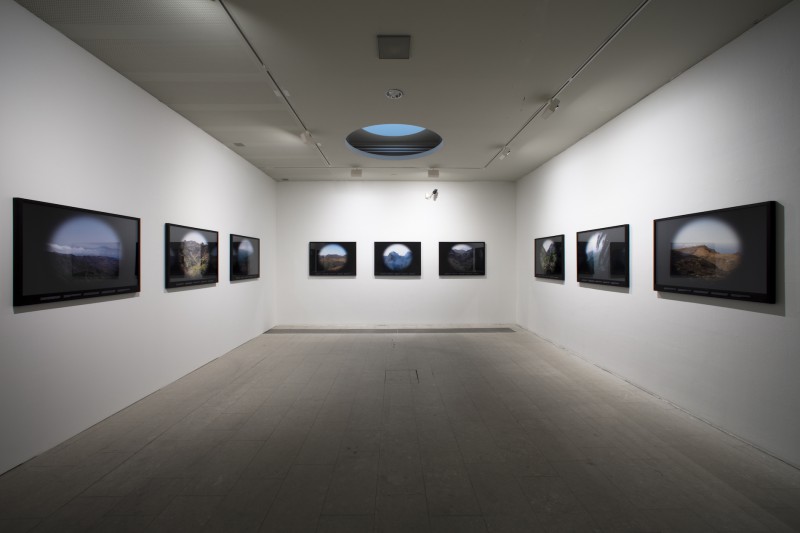
LEGEND (2009) :: text images

installation, 9 lambda prints on aluminium, each with 5 anodized aluminium tags with laser-engraved letters embedded in the wood frames, framed each 74,8 x 104,3 cm, total dimensions variable

etymology: Middle English “legende,” from Anglo-French & Medieval Latin; Anglo-French “legende,” from Medieval Latin “legenda,” from Latin, feminine of “legendus,” gerundive of “legere” to gather, select, read; akin to Greek “legein” to gather, say, “logos” speech, word, reason
1: a story coming down from the past whose truth is popularly accepted but cannot be checked
2 a: writing or a title on an object; 2 b: caption; 2 c: an explanatory list of the symbols on a map or chart

The Latin verb “legere” originally meant "to gather." In time the verb came to mean "to gather with the eye, to see," and that led to the sense "to read." From this verb came the Latin noun “legenda,” used in the Middle Ages to mean "a thing to be read."
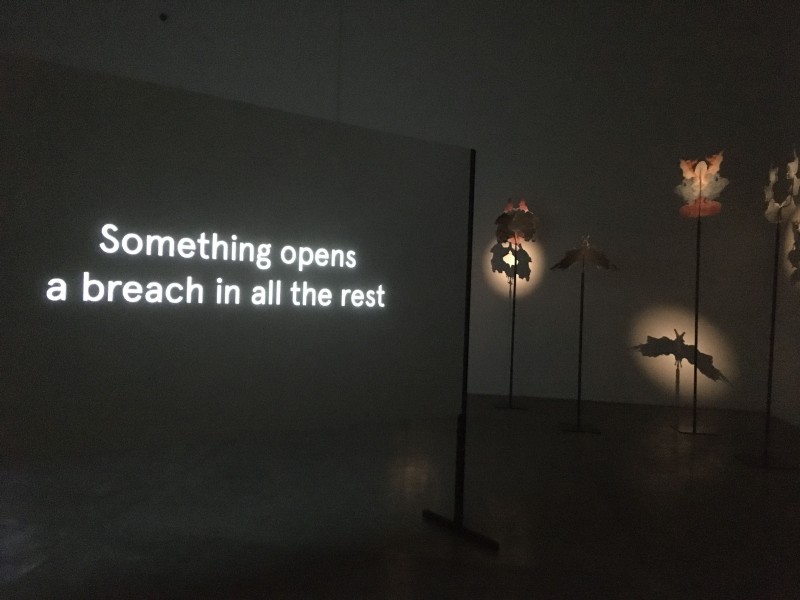
For her new work, LEGEND, Ana Torfs photographed nine landscapes on La Gomera, the second-smallest of the Canary Islands. Assigned to each are five legends with a variety of information about the Canary Islands. The photos, which resemble a view through a telescope, and the engraved metal plates stir associations with nineteenth-century research expeditions and the presentation of their findings in natural history and ethnology museums. Presented are historical, political, and economic facts, but also “legends” in the sense of legendary or mythical reports. For example, according to ancient ideas, the Canary Islands were on the western edge of the world; they were seen as Elysium, the island of bliss where the gods’ favored souls were freed of earthly suffering for time eternal. And Columbus verifiably set sail from here to find the sea route to India. The history of the Canary Islands is likewise one of repression of the native people, waves of emigration, and the terror of the Franco dictatorship. Today, the islands are not only a popular tourist destination, but also the gateway to Europe for those desperate enough to attempt the crossing by boat from nearby Africa. The network of associations and facts yields a multifaceted image; yet despite the abundance of information, it is impossible to get the picture “in focus.”

FAMILY PLOT #1 (2009) :: text images

installation, 25 lambda prints on aluminium and silkscreen on glass, framed each 44,5 x 32,5 cm, total dimensions variable

Some time ago Torfs stumbled upon the figure of Carl Linnaeus (1707-1778), the famous Swedish “Father of Modern Taxonomy.” Before Linnaeus, many naturalists gave the species they described long and awkward Latin names, which could be changed at will. The need for a practicable naming system was intensified by the growing number of plants and animals that were being brought back to Europe from Africa, Asia, and the Americas. Linnaeus introduced the systematic use of binomial nomenclature in Latin, giving plants and animals a generic name and a specific epithet. We owe the name of our species, “Homo sapiens L.” to Carl Linnaeus, who published the term in 1758.* Although he was not the only naturalist to use binomial names, he was the first to introduce this with consistency and precision in his magnum opus “Species Plantarum” (1753).
One could consider the naming politics of the Linnean systematics as a form of “linguistic imperialism”: it accompanied and promoted European global expansion and colonization (ignoring existing indigenous names, for example). “From Columbus to Humboldt the principle of attachment served to make the incommensurable seem commensurable. (…) Attachment allowed for the creation of an initial (if also sometimes troubling) familiarity. It also allowed the discoverer to make some measure of classification. Above all, it allowed him to name, and by naming, to take possession of what he had laid eyes on.”**
The more Torfs studied the history of the binomial classification system, as initiated by Linnaeus “the name giver” the more she was fascinated, and she decided to make a work starting from the official names of very well chosen botanical species and the “naming story” behind them: with the name “Washingtonia robusta Wendl.” the German botanist Hermann Wendland was paying homage to George Washington, first president of the United States. The name “Solandra grandiflora Sw.” was a tribute by Swedish botanist Olof Swartz to Linnaeus’ pupil Daniel Carlsson Solander, who moved to London in 1760, thus promoting the Linnean classification system in England.
Family Plot #1 shows, in a very playful and graphical way — mimicking a genogram, a pictorial display of a person's family relationships — how Linnaeus and his many followers retold the story of the elite of the Western World through their well-managed naming system. It’s also a slightly erotic work, with its close-ups of flowers and fruits from a wide range of plants: a wink to Linnaeus’ own sexual classification system. “Yes, Love comes even to the plants. Males and females, even the hermaphrodites, hold their nuptials (…) The actual petals of a flower contribute nothing to generation, serving only as the bridal bed which the great Creator has so gloriously prepared, adorned with such precious bed-curtains, and perfumed with so many sweet scents in order that the bridegroom and bride may therein celebrate their nuptials with greater solemnity. When the bed has thus been made ready, then is the time for the bridegroom to embrace his beloved bride and surrender himself to her.”*** Instead of looking at the totality of a plant, Linnaeus concentrated on one particular characteristic: the number of stamens (the male reproductive units) and the number of pistils (the female reproductive units) — and organised all plants in twenty-four groups accordingly. This was so controversial at the time that he was accused of being a botanical pornographer…

* In the official format of a binomial scientific name, a person's name, in most cases abbreviated, appears after the genus’ and species’ name, referring to the person who first coined the name and published it in a specialized magazine. The official scientific abbreviation of Linnaeus’ name is L.
** Anthony Pagden, “European Encounters with the New World”, 1993
***“Preludia Sponsaliorum Plantarum” (The Marriage of Plants, 1729)

DISPLACEMENT (2009) :: text images

installation with black and white slide projections on 2 opposing walls (2 loops of 50 minutes), 2 projections socles, wireless headphones, sound, English spoken, digitally controlled, variable dimensions

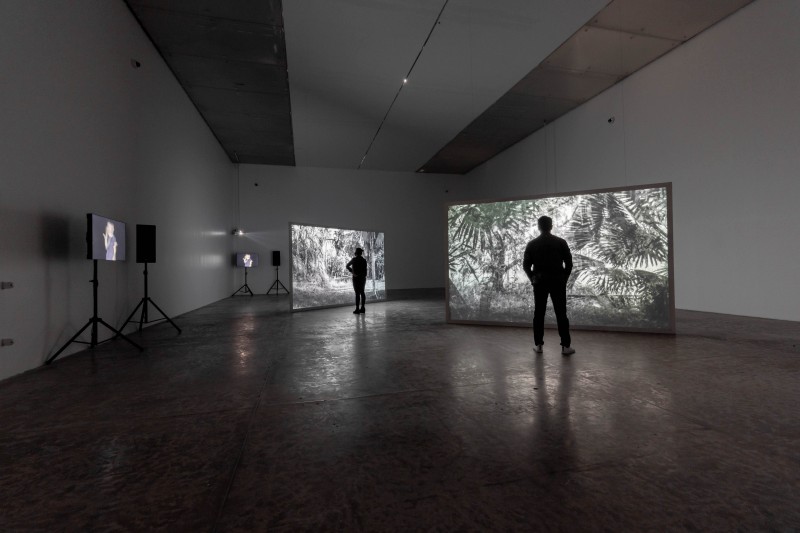
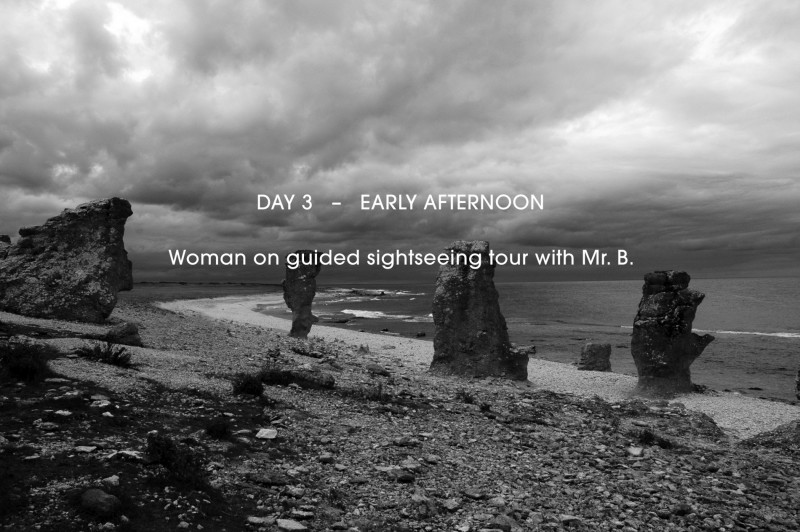
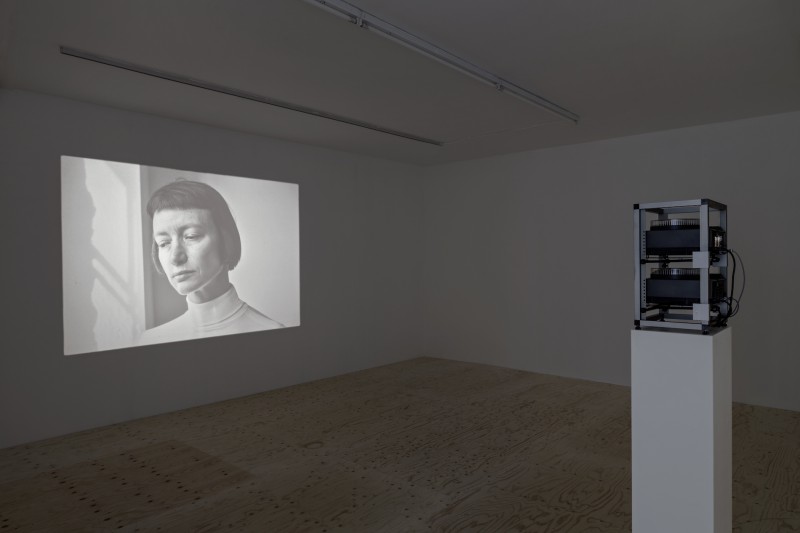
The installation consists of slide projections and a soundtrack that can be listened to via headphones. Large black-and-white images are projected onto opposite walls. On one side, giant, frontal portraits of a man and a woman alternate with the white, illuminated text, ‘every story is a travel story’. The portraits appear and disappear in slow fades, which largely determine the lighting and atmosphere of the overall space. A kind of ‘travelogue’ plays out on the other side. The landscapes and interiors aren’t exactly exotic, but you can’t immediately place them either. Each image is overlaid with a text such as ‘Day 6 – Early afternoon – Man and woman visiting excavation site with Mr. B’. For the most part, there are no people to be seen in the photographs, yet almost all the images contain traces of a human presence: infrastructure, windmills, radars, bunkers, industrial installations, art, archaeological remains, and so forth. No use is made of unusual viewpoints or perspectives: the images present the intriguing, expansive and desolate setting as if viewed through the eyes of a couple of tourists.
There is no title slide and no credits: the installation runs on a loop that the viewer can enter or leave at any point. All the same, there is a definite narrative sequence here, as suggested at once by the text slide accompanying the two portraits. The travelogue is split into seven days, and the viewer gleans minimal hints of a kind of plot. This is fleshed out further when you put on the headphones. There is a brief introduction, following which we hear four different voices in several short dialogues: the story of a man and a woman. The voices here are emphatic and ‘professional’: there is no sign of hesitation, breathing or non-verbal sounds. The actors seem to be reading rather than speaking and you sense that – like the photos in the travelogue – they ‘allude’ to a human presence rather than representing actual characters.
The longer you watch in the gently fluctuating light and shade of this darkened space, the more that the fragmentary totality of texts and silent images evokes the one thing that is nowhere to be seen: a moving picture. The photographs are not merely souvenirs of a journey, they show us locations where something has happened or is about to happen; where characters have performed or will do so; the notes and dialogues, meanwhile, indicate the passage of time. The man and woman in the portraits may well be the ‘man’ and ‘woman’ from the story. Is Ana Torfs showing us the storyboard and script of a future film? Or is she inviting us to invent one ourselves?
What’s happening here is, in fact, essentially the opposite. ‘Displacement’ is the fruit of a production-in-residence in Gotland – a Swedish island in the Baltic Sea. Torfs conceived it from the outset as a ‘remake’ of Roberto Rossellini’s 1954 film ‘Journey to Italy,’ which narrates a marital crisis in the form of a road movie. The straitlaced British couple Catherine and Alex Joyce (played by Ingrid Bergman and George Sanders) realise while travelling through southern Italy that they have grown apart. They are then thrown back into each other’s arms on experiencing a kind of ‘culture shock’. Critics widely view the film – partly because of its unconventional narrative style – as a milestone in cinema history; even as the first ‘modern film’. Torfs pays tribute to ‘Journey to Italy’ by carefully deconstructing it and ‘displacing’ it to remote Gotland: just as the Naples region is the real star of Rossellini’s movie, the Scandinavian island takes the principal role in ‘Displacement’. And just as it does with Rossellini, travel serves as a metaphor for a different journey of discovery. Removed from their familiar surroundings and routine, yet all the more trapped in their own ‘roles’ because of it – sharp-tongued, then nasty and finally nurturing and submissive in her case, and terse and ironic, hard-boiled and ultimately gauche in his – the couple are forced to go in search of themselves and of each other. Unlike Rossellini, however, Torfs doesn’t offer a happy ending: she leaves out the redemptive ‘I love you’. The nameless couple are seemingly condemned to an endless cycle of attraction and rejection.
At first sight, the installation is very different from Torfs’ previous work, in which exterior shots, for instance, feature only very rarely. All the same, ‘Displacement’ raises several familiar themes: the potency of history in the present and the handling of testimony and relics from the past (Torfs intensifies this theme, which is also central to Rossellini’s movie, by acknowledging the film itself as a ‘historical artefact’), the relationship between text and image, association as a method and the issues associated with the portrait.

Catherine Robberechts

actors appearing in slide photographs
Carlotta Sagna and Jean Luc Ducourt

voices
Brian Flack, Debbie Phillips, Richard Wells, Cathy Smith, and John Boyle

piano
Piet Kuijken

VÉRITÉ EXPOSÉE (2006) :: text images

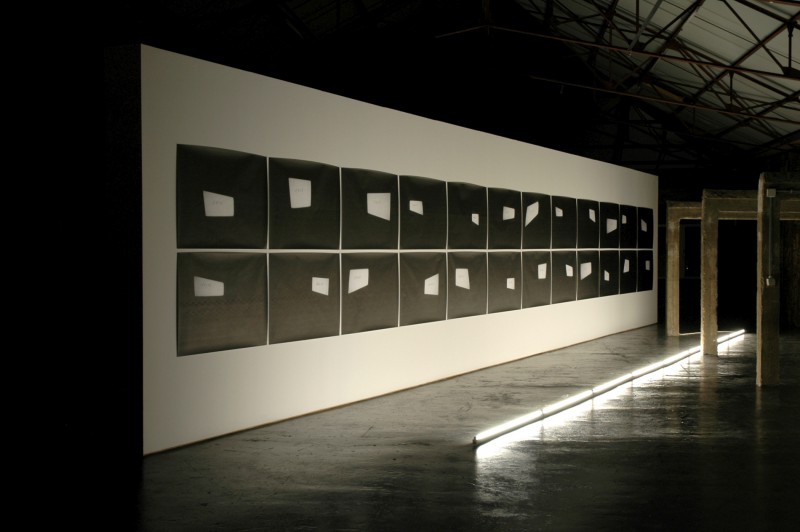
24 xerox prints, 80 x 116 cm, wall-filling installation, variable dimensions

Now, is film indeed the truth, 24 times a second, or rather a couple of dozen different truths, or simply all lies? In a playful way, Ana Torfs deconstructs this cinematographic sophism in a series of 24 posters, variations on a theme.

ANATOMY (2006) :: text images

installation with black and white slide projections (loop, 34') and video on two monitors (colour, loop 90'), projection socle, sound, German spoken, English interpretation via wireless headphones, digitally controlled, variable dimensions

We can no more master the past than we can undo it. But we can reconcile ourselves to it. The form for this is the lament, which arises out of all recollection. It is, as Goethe has said (in the dedication to Faust): ‘Pain arises anew, lament repeats Life’s labyrinthine, erring course.’ The tragic impact of this repetition in lamentation affects one of the key elements of all action; it establishes meaning and that permanent significance which then enters into history. In contradistinction to other elements peculiar to action - above all to the preconceived goals, the impelling motives, and the guiding principles all of which become visible in the course of action - the meaning of the committed act is revealed only when the action itself has come to an end and becomes a story susceptible to narration. Insofar as any ‘mastering’ of the past is possible, it consists in relating what was happened; but such narration, too, which shapes history, solves no problems and assuages no suffering; it does not master anything once and for all. Rather, as long as the meaning of the events remains alive - and this meaning can persist for very long periods of time - ‘mastering of the past’ can take the form of ever-recurrant narration.
(Hannah Arendt, ‘On Humanity in Dark Times, Thoughts about Lessing’, 1968)

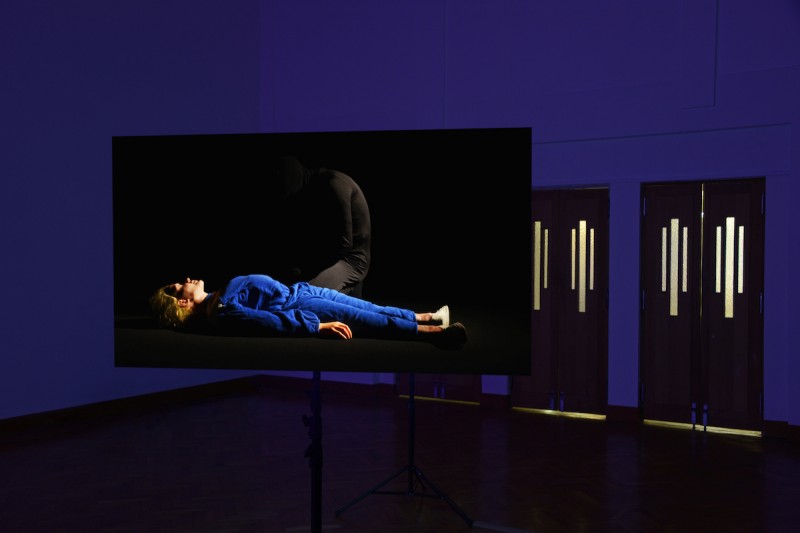
During her scholarship as a DAAD artist-in-residence in 2005/2006 Ana Torfs researched in the Freiburg Military Archive on a trial held in May 1919, the ‘Case of the Murder of Dr. Karl Liebknecht and Rosa Luxemburg before the Military Field Tribunal of the Cavalry Guard Rifle Division in the Main Courtroom at the Berlin Criminal Court’. She pinpointed selected statements from this trial to compose ‘A Tragedy in Two Acts,’ the literary script for her installation with the ambiguous title ANATOMY.
Torfs chose 25 young Berlin actors to ‘play’ specific testimonies from the record of the proceedings, and filmed their performances on video. Another 17 actors of different ages, including Therese Affolter, Judith Engel, Stefan Lisewski and Matthias Matschke, posed for the artist for black and white slide photographs. Torfs chose to set the scene in the demonstration room of the Anatomical Theatre in Berlin, built from 1789-1790 by the architect Carl Gotthard Langhans, whose most famous realization is the Brandenburg Gate. The result is an installation that interlinks big-screen slide projections with video images on two monitors.
The absurd show trial of Luxemburg and Liebknecht’s murderers includes a considerable amount of harrowing detail on how the murders were actually committed. The video recordings show a kind of slow process of dying, told from the perspectives of 25 different witnesses and defendants. The case files have been cut up by Torfs into short scenes so that a ‘story’ emerges in which details from the same event are told from different angles, highlighting the relative nature of the narrative.
The 25 actors recite the testimonies in German, but over wireless headphones the visitor of the exhibition can listen to an English ‘live’ version spoken by a conference interpreter. The focus is on language, and of course language is never objective. Ultimately the concise text that Torfs selected and ‘constructed,’ the so-called ‘Tragedy in Two Acts’ - though based on a particular trial - becomes universal and is reminiscent of any political murder case, whether it was committed then or now, but at the same time it has the force of a Greek tragedy.
The (mute) slide projections in Torfs’ installation provide a more abstract visual counterpoint to the video images. The architecture of the Berlin Anatomical Theatre evokes a very suggestive atmosphere somewhere between a stage, a Greek amphitheatre and a court of law. This location is ideally suited to Torfs’ work: the scene of so many dissections and analyses, it reflects various aspects of Torfs’ own artistic process as she takes a scalpel to the texts she chooses to work on. The intriguing images Torfs photographed in this historic setting, with actors of 4 different generations, aged between 25 and 80, can be read in many different ways, but first of all they might be seen as a Greek choir. Like the angel in Paul Klee’s picture Angelus Novus they seem to ‘stare at something with their eyes wide open. Their faces are turned toward the past. Where a chain of events appears before us, they see one single catastrophe, which keeps piling wreckage upon wreckage.’* But the stage-setting might just as well refer to an image of a genuine audience ‘we’, ‘us’, witnesses, looking at the bleeding corpse of Western History.
The book ANATOMY, published in conjunction with the exhibition, contains text and photography by Ana Torfs including the ‘Tragedy in Two Acts’ and a personal text about the creation process of the installation. See also : bibliography > artist’s books, limited editions & solo exhibition catalogs

* Walter Benjamin, On the Concept of History, 1940

actors appearing in slide photographs
Therese Affolter, Peter Becker, Gabor Biedermann, Meike Droste, Judith Engel, Doris Egbring-Kahn, Eva-Maria Hofmann, Tim Lang, Ursina Lardi, Stefan Lisewski, Maria Mägdefrau, Matthias Matschke, Fred Schmidt, Dagmar Schwarz, Stefan Sieweke, Ursula Staack, and Horst Westphal

actors appearing on video
Alexander Altomirianos, Jens-Uwe Bogadtke, Matthias Dietrich, Paul Enke, Stefan Faupel, Florian Jahr, Daniel P.P. Komma, Christian Arnold Krüger, Robert Krüger, Gisela Künitzer, Martin Langenbeck, Karl-Sebastian Liebich, Hannes Lindenblatt, Hagen Löwe, Carmen Maretzky, Susanna Metzner, Julian Meyer-Radkau, Bastian Michael, Thomas Niehaus, Denis Pöpping, Peter Priegann, Philipp Richardt, Hans-Henning Stober, Florian Wegner, and Claas Würfel

interpreter German-English
Ana Kacic

THE INTRUDER (2004) :: text images

installation with black and white slide projections on black projection surface, projection socle, 4 loudspeakers on tripods, sound, English spoken, +/-35 minutes, loop, digitally controlled, variable dimensions

The everyday: what is most difficult to discover. In a first approximation the everyday is what we are first of all, and most often: at work, at leisure, awake, asleep, in the street, in private existence. The everyday, then, is ourselves, ordinarily. (…) Boredom is the everyday become manifest: as a consequence of having lost its essential–constitutive–trait of being ‘unperceived’. Thus the daily always sends us back to that inapparent and nonetheless unhidden part of existence: insignificant because always before what signifies it; silent, but with a silence that has already dissipated as soon as we keep still in order to hear it, and that we hear better in idle chatter, in that unspeaking speech that is the soft human murmuring in us and around us.
(Maurice Blanchot, ‘Everyday speech’, 1969)

THE INTRUDER, an installation with slide projections and audio narration, is based on ‘L’Intruse’ (1890), Maurice Maeterlinck’s second play, which was performed for the first time in May 1891 in Paris (directed by Lugné-Poe) at a benefit event for the painter Paul Gauguin and the poet Paul Verlaine. This one-act play had achieved a cult status by the end of the 19th and the beginning of the 20th century and it was translated in the most unimaginable languages, all over the world. It was staged by none other than Vsevolod Meyerhold in 1903 but also by Konstantin Stanislavsky, the father of ‘method acting’ in 1904.
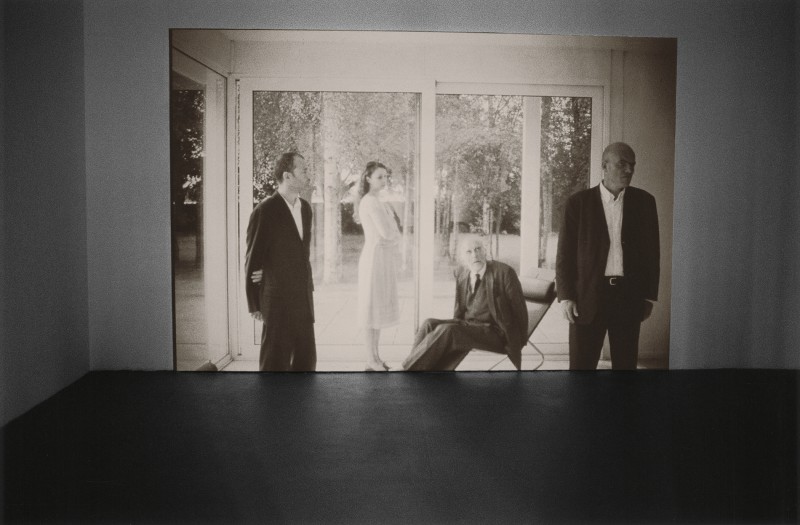
Torfs has always felt strongly attracted to the early Maeterlinck plays, with their Beckett-like language.* In 2004, she invited Gila Walker to make a new translation of the French play into English**. Torfs reduced the text to its essence. She changed the gothic setting of the play into a villa with a modern interior - ‘the action takes place in modern times’*** - a strictly functional decor. She introduces the five archetypal characters while they are waiting in the living room of a modern villa facing a garden, on a Summer evening: the blind grandfather, his son, his son-in-law, his granddaughter and a maid-servant. Off-screen, the voices of five other actors accompany the slide photographs with theatrical intonation.
The slides are projected on a black projection surface, a radical and very suggestive conceptual choice, creating a eerie atmosphere. It could also be seen as a playful reference to ‘day for night’. Day for night, also known as ‘nuit américaine’ (American night), is the name of a cinematographic technique to simulate a night scene. Mainly intended to avoid costly night filming, outside scenes can instead be shot during the day, with special filters and under-exposed film to create the illusion of darkness or moonlight. The ‘filtered’ slide photographs that appear on Torfs’ black projection surface are also reminiscent of early photography and daguerrotypes, with different hues in the range of brown and bronze tones.
What we see is the ‘positioning of a family’, operating within a tightly confined space. Over and again the short, at times absurd dialogues return to the sensory perceptions of hearing and seeing. The father: ‘There’s an extraordinary silence.’ - The uncle: ‘That’s exactly what I don’t like about the country.’ Or: The father: ‘We can’t stay like this in the darkness.’ - The uncle: ‘Personally, I don’t mind talking in the dark.’ Torfs similarly subjects the viewers in the exhibition space to a strange rhythm of shifting impressions. Sometimes the slides are interrupted by intertitles; at other times obvious changes in position follow one another in the sequence; at times almost identical images are rapidly crossfaded, creating a sense of puppet-like motion. The anti-naturalistic delivery of the text by the British voice actors underscores the stylisation of the piece by Torfs and hence all the more clearly foregrounds the minimalistic structure of the one-act play. Nothing seems to happen, apart from waiting, on a long Summer evening. The wait itself, and through it consciousness of time, become one of the installation’s dramatic issues. ‘What are they waiting for? They do not know! They are waiting for someone to knock on the door, waiting for the light to fade out, waiting for Fear, waiting for Death. Do they speak? Yes! They speak a few words, breaking the silence for a moment, then they begin listening again. Leaving their sentences unfinished and their gestures interrupted. They listen, they wait. Perhaps she will not come? Oh! She will come. She always comes. It is late, maybe she will only come tomorrow. And the people gathered in the big room begin to smile and to hope. There is a knock on the door. And that is all; this is the whole of their lives, this is the whole of life.’ ****

* In 1985, while still a student, Torfs already made a radio play based on ‘L’Intruse’.
** the first new English translation since 1894
*** opening sentence of the play
**** quoted from Remy de Gourmont, ‘Le livre des masques’, 1896

actors appearing in slide photographs
Mil Seghers, Jean Torrent, Erik Thys, Ans Nys, and Anne Deligne

voices
Paul Gray, Jonathon Sawdon, Michael Cockburn, Maria Aitken, and Diane Gray

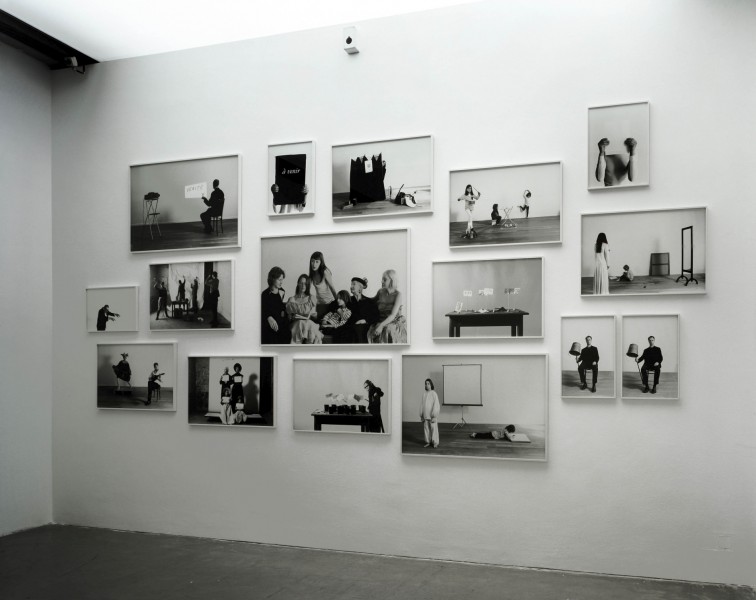
“à…à…aaah!” (2000-) APRÈS COUP (2003) :: text images

framed silver gelatin prints of different sizes in wall-to-wall installation*, variable dimensions, series in progress since 2000
slide projections**

And firstly the desire (the need?), ‘nel mezzo del cammin di nostra vita,’ to go back to the origin when nothing was decided yet but everything was already taking shape. To ask the critical question of how it all began and to answer with the first-born letter, the small ‘a’ at the beginning. ‘A’ as in childhood, and perhaps the childhood of art too, at least for those willing to recognize that art may be nothing but the keen recollection, the fanned embers of a certain state of shaky accomplished perception of the world and of the self.
This, then, would be the beginning. The self, the word, the appropriation of one by the other through play: games of roles, identities, and objects. Theatre, in short. Theatre first and foremost. As a womb out of which everything proceeds: pictures, sounds, words (‘Words, words, words’), singing, and all the uncertainty that will end up contaminating the very foundations of the real. If I'm not me then who can you be? And what truth is this that seems to pass through a small insistent sailor shirt or be trumpeted by an instrument of hollow fame? Slippage, illusion, uproar. The world is a stage, but when children appear on it to play the comedy, it is always with such immense earnestness.
Which means that they can lose their heads in it (like a certain king who was not convincing enough as a servant and so had his cut off) or lose sleep over it (dreams, puzzling signs, fallen castles, antics, masks, opaque screens, faceless figures and reflectionless mirrors). And no remedy this time, no hope for help from Dr. Sigmund: Oedipus still erring blind, blundering in the darkness of a dream. Happily, the ancient chorus of women is keeping watch and it will know how to tell the story. From then on, the child, trusting and with no holds barred, will immerse herself in the book.
This is how A’s childhood was spent. This is how I imagine it. Turning back to it in the middle of the way of an artist’s life, speaks of recognition, in both senses of the word. Firstly of giving homage where homage is due: we move then from the small initial ‘a’ of childhood to the preposition with an accent, the ‘à’ that is the mark of the dative case in French, the indirect object; and here giving takes on the full meaning of a restitution. Secondly of recalling and identifying what once was, with a sort of refound self-evidency that is surely what elicits the exclamatory aaah! of delight in the title. But I’m writing of this in words only, whereas Ana Torfs' images are mute, meaning they are eloquent. Like the ‘in-fans,’ the infant lacking language but not insight.
(Jean Torrent, text written on the occasion of the exhibition in ‘het Kabinet’, Ghent, 2003)

* After these photographs had first - quite aptly - been brought together for Torfs’ exhibition entitled “à…à…aaah!” (écrans, Dark Pictures, Redites, Essais de frontispice et autres vignettes) in the window gallery ‘Het Kabinet’ (the cabinet) in Ghent in 2003, they were not intended to be shown together again. But to Torfs’ surprise other invitations followed to make a wall-filling installation with the photographs. Apart from this wall-to-wall installation, which had been named "à...à...aaah!” ever since the first exhibition in Ghent, each photograph also exists as a work in its own right, with a title of its own. See also: works > photographs & prints
** For the exhibition in Ghent Torfs also made a work with slide projections entitled APRES COUP, containing 81 text slides with handwritten rhyming words, a playful work which is not without wit…

ELECTIVE AFFINITIES/THE TRUTH OF MASKS & TABLES OF AFFINITIES (2002) :: text images

installation with black and white slide projections on 2 freestanding projection walls, 2 projection socles, +/- 20 minutes, loop, digitally controlled, variable dimensions
14 tables with the unfolded sheets of a ‘book-in-the-making’, 70 x 100 cm
38 prints, variable dimensions

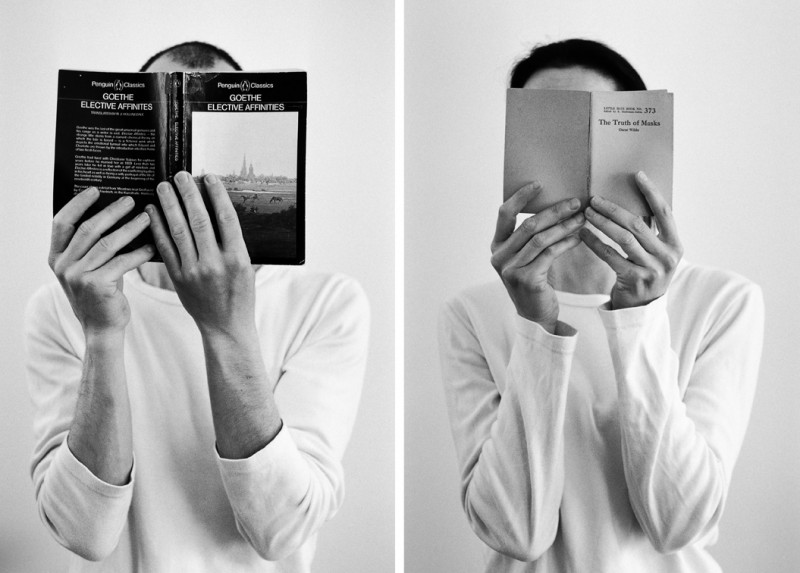
Text and image occupy an equally important place in this installation, as elsewhere in Ana Torfs’ work. First of all there is a double series of portraits, black and white slides projected in pairs on two freestanding walls; a man and a woman, counterparts. They are clearly the same man and the same woman each time, but they are nevertheless different: a masquerade. As the clothes, hairstyles and accessories change, so too do the period and the social context you, the onlooker, ascribe to them, and so does their psychology: self-assured or timid, vulnerable or harsh, intelligent or narrow-minded, cheerful or sombre… Some characters you would like to get to know, others are repellent. You often think you recognize someone, but you are never quite sure. You also speculate about the couples: can she really be with him, could he possibly fall for her? Sometimes the affinity is obvious, sometimes it is inconceivable. But when it comes to love, you never know… Despite the pared down simplicity of the portraits and the sober black and white, there is also something light-hearted and sometimes even hilarious about the series as a whole, as with those cheap cardboard dolls children dress over and over again in a new paper outfit, managing to alter their appearance in a very simple and yet quite amazing way. Each model looks straight ahead, impassively: the mixed identities of one and the same anonymous person. At some stage you find yourself wanting to get to know the ‘true face’ of those two people. You try to do this by a process of reduction, but then so little is left: the dimple in his chin, the lines around her mouth, and of course the sex. But then: some characters are quite androgynous, and is that dimple, are those lines really so unique? No, the portraits tell us nothing about the model ‘behind’ them, there is no ‘behind’, only an empty projection screen. A series of variations without a theme.
Lying spread out on fourteen tables are the unfolded, printed sheets of a ‘book-in-the-making,’ a sort of reading diary in which the artist combines excerpts from various literary, (auto)biographical and historical works in a very free and associative manner. The slide series, a seemingly endless masquerade for two models who never show their ‘true face,’ can be linked at will with these texts, but can equally well be read as a light-hearted questioning of such concepts as truth and identity. In the light of the often radical ‘resistance’ of individuals to intolerance, alienation and extremism, a central theme in the miscellany presented here, these questions acquire a very different weight.
This ‘book-in-the-making’ has taken up 2 other “forms” as well. See also: bibliography > artist’s books, limited editions & solo exhibition catalogs
(Catherine Robberechts in ‘ForwArt, a Choice,’ 2002)

actors appearing in slide photographs
Catherine Lemeunier and George Van Dam

DU MENTIR-FAUX (2000) :: text images

installation with black and white slide projections, projection socle, +/- 20 minutes, loop, digitally controlled, variable dimensions, text slides available in English or French
artist’s book on reading stand/table in French/Dutch/English

What strikes me about a trial is the deluge of words around a silence. 'Did this woman kill her husband?' For days the truth is sought, while the woman knows it and allows herself to be entrapped, attacked and defended. Every work of art is conceived like this, around a silence - a silence which knows but which keeps the secret for the sake of the lie it fears, that turns it inside out, depriving it of its support.
(Georges Perros, ‘Papiers collés,’ 1960)

DU MENTIR-FAUX consists of an installation with slide projections and a book. The slide projections show a long series of black and white portraits. An extremely sober composition: a series of portraits of a young woman, quiet, without attributes. Her face conveys suffering. The acting, the pose were reduced to their essence, as if inviting the spectator to decipher the code. From time to time, the series is interspersed with texts containing questions. Something in the young woman’s pose, style and hairdo sparks a feeling that is confirmed when we glance in the accompanying book: we’re looking at a portrait of Joan of Arc - a theme to which Ana Torfs had already devoted a short video in 1988. The questions, so tormenting the protagonist, turn out to be quotations from the reports of the inquisition trial carried out against her in the 15th century.
The book, with an introductory essay by Dirk Lauwaert, comprises, apart from a selection by Torfs from these trial reports, an autobiographical text by her own hand, in which she bears witness of her fascination for the figure of Joan of Arc: not as the political or national symbol, but rather as the all too physical, self-willed yet ultimately defenceless victim of an all powerful system. The title DU MENTIR-FAUX (About Lying Falsehood) is not a quote, but it alludes to the tautological style of medieval texts which is so alienating to the contemporary reader; Jeanne d'Arc’s prosecutors kept making use of notions like ‘fiction mensongère’ (mendacious fiction) or ‘feindre mensongèrement’ (mendaciously pretending). DU MENTIR-FAUX can also be understood as a reference to the impossibility, in spite of all the testimonials and documents, of getting at the truth, or in a broader sense to the insoluble tension between fiction (constructing, pretending, lying…) and genuine reality.
See also: bibliography > artist’s books, limited editions & solo exhibition catalogs
(Catherine Robberechts, press text Palais des Beaux-Arts, 2000)

actress appearing in slide photographs
Dominique Licoppe

BATTLE (1993/2009) :: text images

installation with high definition video projection (1920 x 1072 pixels) and slide projections on adjacent walls, sound, Italian spoken, English translation, 2 loops of +/- 20 minutes, digitally controlled, variable dimensions

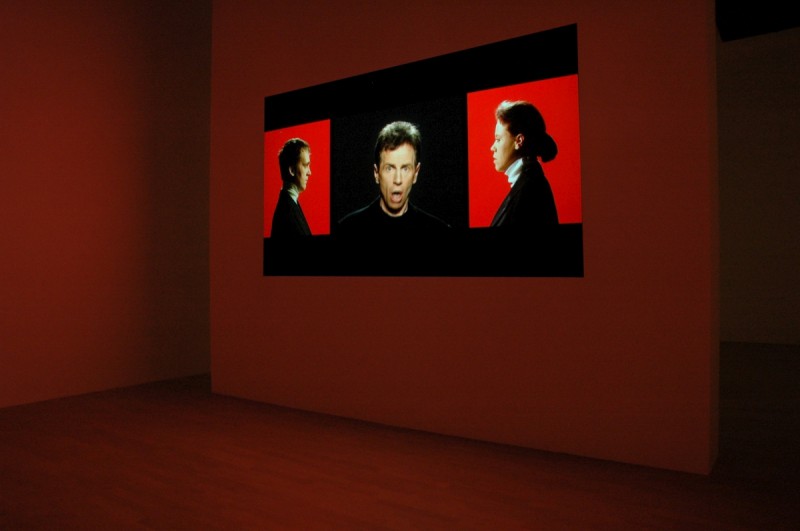
For her installation BATTLE, formerly known as IL COMBATTIMENTO, Torfs chose to work with a ‘scenic madrigal’ for three voices by Claudio Monteverdi*. The libretto of this composition was based on Canto XII of Torquato Tasso’s ‘Gerusalemme Liberata’ (1579), a romance set against the backdrop of the First Crusade. Tancredi, a Christian soldier, has fallen in love with Clorinda, a Saracen girl. The episode set by Monteverdi as a work to be acted, ‘in genere rappresentativo,’ as opposed to others ‘senza gesto’ (without gesture) concerns the encounter of Tancredi with a mysterious opponent. They meet on the battlefield, by the walls of Jerusalem, unrecognisable in their armor. They fight and the mysterious knight is deadly wounded; Tancredi then discovers that he has killed his beloved Clorinda.** The clashing of swords, galloping horses, Clorinda’s ascent to heaven - Claudio Monteverdi made all this audible in this composition. He chose a text that explores the relationships between war and love: as a soldier storms a fortress, so does a lover lay siege to his adored one's reticent heart: ‘Three times the knight grips the woman in his strong arms and the same number of times does she break free of those strong bonds (…) weary and panting, both must draw apart at last and draw a breath after a long labour.’ Monteverdi’s composition was first performed in Venice in 1624 but not printed until 1638, when it appeared with several other pieces in his eighth book of madrigals (written over a period of many years). Monteverdi's introduction to the later publication declares that it was staged at the Palace of the Most Illustrious and Most Excellent Signor Girolamo Mozzenigo, his particular patron, a knight of very good and delicate taste, as an evening carnival entertainment in the presence of the entire nobility, nearly moved to tears and vociferous in their applause.
Torfs’ ‘video triptych’ allows the heads of the three performers to be shown individually, the singer of the narrative (‘il testo’, performed by Richard Jackson) face on in the middle, and the crusader Tancredi (performed by Mark Oldfield) and the pagan maiden Clorinda (performed by Zofia Kilanowicz) as pendants in profile on either side. Two of them, Tancredi and Clorinda, barely sing. The third character, the observing ‘testo’ or narrator describes the acts performed by the other two.
Torfs reduces opera to pure breathing, swallowing, vibrating, and the location of a voice in a body, to mouths that open and close. The body’s gestures are reduced to the gestures of the face and the physical act of singing. Through the complete absence of historical setting and period costumes the text regains in explosive directness. ‘The ‘blankness’ of the singers’ faces - after all, singers ‘perform’ the drama with their voices, not through facial expressions - contrasts strangely with the emotions evoked by their music, the savage action being narrated and the passion of the characters they represent.’***

* Il Combattimento di Tancredi e Clorinda
** Luciano Berio arranged the work in 1966 for a performance that was meant as a Vietnam War protest at the Juilliard School in New York.
*** Catherine Robberechts in ‘Impossible Portraits’, 2002

actors
Richard Jackson, Zofia Kilanowicz, and Mark Oldfield

music
Herman Stinders, Johan Van Aken, Heidi Verbruggen, Frans Vos, Mark Lambrecht, and Maurice Aerts

translation
Ana Kacic

thanks to
vzw soil and Astrid Vehstedt

APPROXIMATIONS/CONTRADICTIONS (2004) :: text images

web project, German with English translation, requires Adobe Flash player 6 or higher, speakers or headphones are required

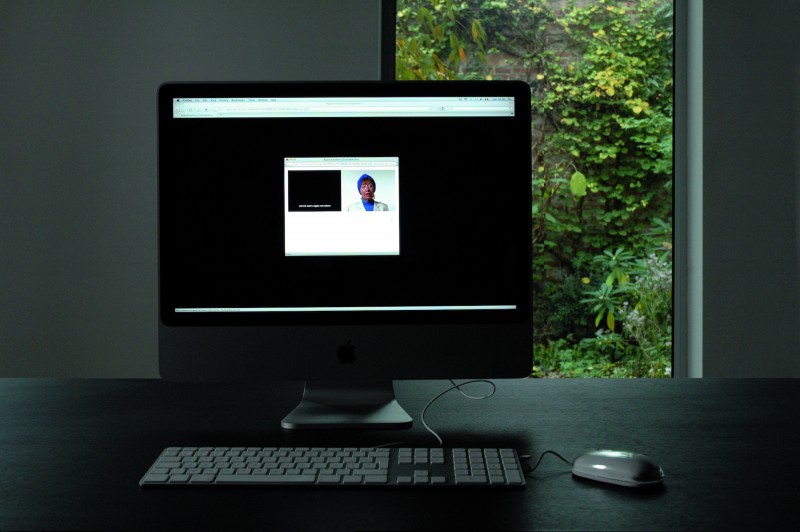
For APPROXIMATIONS/CONTRADICTIONS, her first web project - commissioned by Dia Art Foundation - Torfs focused on the Hollywood Songbook, a collection of 49 very brief, haiku-like songs written by the German-Austrian composer Hanns Eisler in 1942 and 1943 while he was in exile in California. She elicited powerful performances from 21 very talented, diverse people singing the songs, and weaves them together into something entertaining and beautiful yet deeply disturbing and compelling. Through his compositions for the Hollywood Songbook, Eisler was interested in translating his impressions of war, exile, and Hollywood. While the lyrics for these 49 compositions include texts by Hölderlin, Rimbaud, Goethe and others, the lyrics of the 21 songs selected by Torfs for her web project were all written by Bertolt Brecht, Eisler’s frequent collaborator in Berlin before both men fled Germany in 1933.
Torfs researched Eisler’s work extensively, formulating an idea of how he would have intended this material, both dark and witty (Contradictions), to be performed. Her assumptions were confirmed by Irmgard Arnold (born 1919), a German soprano Torfs befriended, who worked intensively with Eisler in the 1950s. Torfs searched for twenty other character performers, primarily actors and singers of multiple nationalities living in Belgium, most of whom are not classically trained.
In APPROXIMATIONS/CONTRADICTIONS Torfs filmed 21 performers, creating ‘close-up portraits’ of each singer performing three evocative versions (Approximations) of a song. Interested in responding to the setting in which people typically view the web, Torfs offers a kind of intimate cinema. 21 performers were filmed in three different ways, turning us into witnesses of their transformation from ‘person’ to ‘character/figure’. Playing off the convention of cast credits at the end of films, three versions of each song are offered from the project's main page, with song titles in the position of the role.
The first version (linked to each performer's name) shows each one mentally singing the song while listening to the piano. During the rehearsals for the project, Torfs discovered that every singer very quickly ‘acted’ the song in a very specific way. For the second version, (accessible by clicking the line connecting the name to song title) Torfs asked the singer to be conscious of this and to repeat it. This version also presents Piet Kuijken, the young pianist whose face tells as much as his interpretation of the music. For the third version (linked to each song title), Torfs asked the performers to gaze directly into the camera, and asked them to wear something they felt was appropriate to the subject of their song, as if they were being filmed for a musical. Contrary to the first version where everyone is dressed in a neutral white, in this final one, the women wore makeup and their hair-styles often varied dramatically.
Torfs filmed the performers in close-up, framing them in a style consistent with a portrait: a bust with a little headroom, cropped mid-chest, with a white background. Yet these three different renditions have extremely varied impacts. Watching the first, devoid of language as in a silent movie, one can sense the performer's concentration, singing even while mute. English translations of the original German lyrics accompany the second and third versions. The second version feels, as the first did, slightly voyeuristic, watching the performers sing in a very personal style. And in the third version, with the singer gazing directly at the camera, the viewer is intensely engaged by the performer's metamorphosis into a ‘role.’
(Sara Tucker, from the introduction to the web project)

press release

actors
Irmgard Arnold, Kobe Baeyens, Esmé Beysens, Esmé Bos, Marijs Boulogne, Vera Coomans, Kris Dane, Koen De Cauter, Viviane De Muynck, Jim Denley, Madiha Figuigui, Lucy Grauman, Claire Haenni, Filip Jordens, Cécilia Kankonda, Simonne Moesen, Dett Peyskens, Zahava Seewald, Olivier Thomas, Hilde Vanhove, Bruno Vanden Broecke.

piano
Piet Kuijken

ZYKLUS VON KLEINIGKEITEN (1998) :: text images

35 mm feature film, black and white, 86 minutes, dolby SR, German spoken with English, French or Dutch subtitles

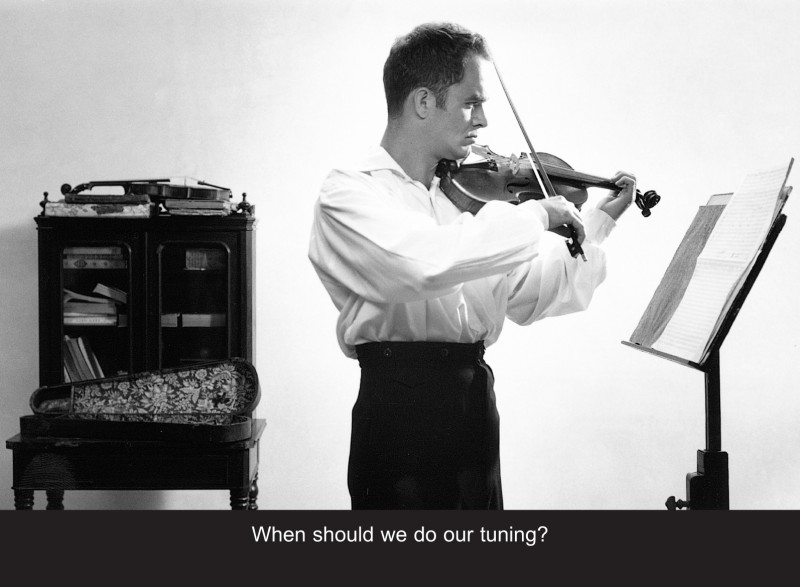
In the margin of the sketches for his composition ‘Bagatelles’ opus 126 Ludwig Van Beethoven wrote: ‘Ciclus von Kleinigkeiten’. The word ‘bagatelle’ means a trinket, niknak, bauble, trifle… These ‘little things’ demonstrate the extent to which the composer had moved beyond conventional generic models inherited from the classical tradition toward the conception of a musical work made up by a number of strongly contrasting miniatures. ZYKLUS VON KLEINIGKEITEN (Cycle of Trifles) is the only feature film by visual artist Ana Torfs. For this radical conceptual movie she drew upon Ludwig Van Beethoven’s so-called ‘conversation books’. These allowed others to ‘talk’ to the famous composer after his hearing deteriorated dramatically in 1818, at the age of 48. Visitors had to make themselves intelligible by writing in these notebooks he always carried with him, until his death in 1827. ‘Should it be played without interruptions?’ the violinist Karl Holz wrote down while studying the score of the string quartet opus 131 or: ‘When should we do our tuning?’ The conversation books read like a sphinx’s riddle: many questions, few answers. Beethoven could speak in response, so his written reaction was mostly absent, leaving a series of one-sided conversations. The conversation books contain the words that were literally addressed to the deaf composer during some of the most important phases of his last years: they conserve as it were, what happened all around him. ZYKLUS VON KLEINIGKEITEN provides an insight, albeit literally one-sided, into his everyday life, through very stylised and timeless black and white scenes. Shreds of a life lived: That’s what Ana Torfs offers us in ZYKLUS VON KLEINIGKEITEN. Shreds of text and image given to us with the utmost attention and precision. It is in-between all of these indisputable images and texts, however, that Beethoven comes to life. In the silence between a question and an answer, in the gap between image and sound, between a sip of wine and a spoonful of hot apple sauce. In the infinite space which Ana Torfs created for Beethoven between all these trifles. In 1999 Torfs made a ‘book translation’ of the film, BEETHOVEN’S NEPHEW, published by Yves Gevaert.
See also: bibliography > artist’s books, limited editions & solo exhibition catalogs

actors
Stanley Duchateau, Guy Dermul, Paul De Clerck, Alain Franco, Johan Heestermans, Nicolas Houyoux, Catherine Lemeunier, Gorik Lindemans, Bart Meuleman, Mil Seghers, Herman Sorgeloos, Erik Thys, Jean Torrent, George Van Dam, Bernard van Eeghem, Hilde Wils, Bella Wajnberg a.o.

voices
Joe Brainin, Brigitta Bürger-Ützer, Georg Diener, Paul Divjak, Gerhard Jäger, Thomas Korschill, Patricia Linden, Michael Moser, Herwig Knaus, Michael Palm, Andrea Pollach, Hanna Schimek, Charles Ulbl, Stefan Wagner, Georg Wasner a.o.

music
Quatuor Danel

Place #1 (Texas Hollywood, Tabernas Desert, Spain) (2010) :: text

lithography, 2 colours (silver and black), 56 x 76 cm

Ana Torfs made a lithograph in the acclaimed series of k20k21 editions, on the occasion of her solo exhibition ALBUM/TRACKS A in K21. The title of the work is ‘Place #1 (Texas Hollywood, Tabernas Desert, Spain)’. It was printed in the workshop of Edition Copenhagen in Denmark. For more info please contact K21.

Lithograph, © photograph of lithograph: Achim Kukulies, 2010
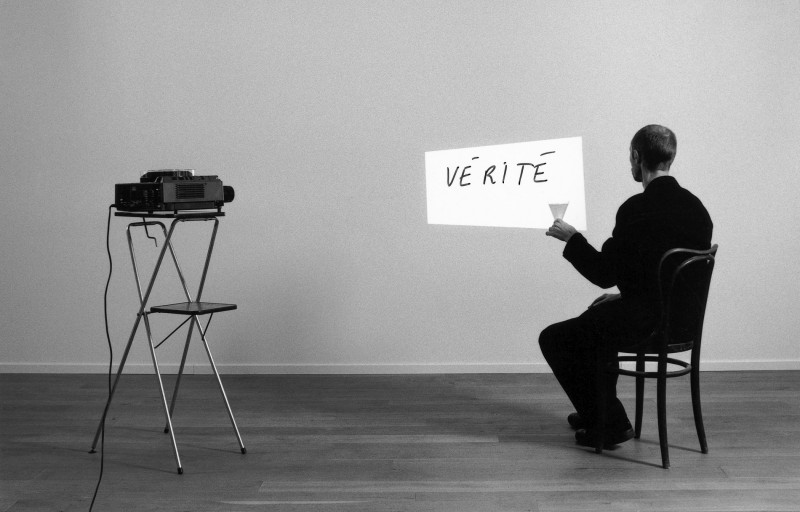
TOAST (2003) :: text

silver gelatin print mounted on aluminium, framed, 80 x 120 cm

I’m looking but I’m not sure how well I see. In one of the photographs that Ana Torfs presented at her exhibition with the title ‘à…à…aaah!’ in Kabinet gallery in Ghent (2003), a man is seen in three-quarters profile sitting on a chair, his back to the camera. He is holding a glass of champagne in his left hand. Instead of bringing it to his lips, he raises it away from his body in mid air, where it stands out sharply against a rectangle of light cast diagonally on the rear wall by the slide carousel in the left foreground. The photograph bears a title: TOAST. This then is what the man in the photograph is doing. But whom or what is he toasting? A word is written on the white surface whose shape and size immediately bring to mind those of a screen: ‘Vérité’ (truth). If I had to choose a single picture in Ana Torfs’ body of work that most accurately conveys its unswerving course, it would probably be this one. It’s all there: the picture, the word, the title, the film screen, and the search for truth, but with no naivety and nearly without hope, for the man is seen from behind and truth is a word projected onto a wall - might as well say a pipe dream. (…) All the questioning, the calling and the searching revolve aimlessly around an absent and meaningless core: truth is but a word projected onto a wall, an illusion traced by finger on the fogged-up surface of a mirror, which a single breath can erase.
(Jean Torrent in: ‘Correspondences’, 2004)

silver gelatin print mounted on aluminium, framed, 80 x 120 cm
RETOUR AUX SOURCES (2003)
silver gelatin print mounted on aluminium, framed, 80 x 120 cm
TROMPE-L’ŒIL (2003) :: text

silver gelatin print mounted on aluminium, framed, 40 x 60 cm

Oedipus seeks the truth, finds it and loses his sight as a result, Tiresias has an eye too many, and Freud in Torfs' 2003 photograph, aptly entitled Trompe-l'œil, literally ‘deception of the eye,’ is a blindfolded old man, arms outstretched to avoid the annoyance of colliding brutally into the other or knocking against the silent chorus of things. He is the man who knows and who reels from knowing but who, despite all his knowing, is nonetheless destined, as we all are, to die.
(Jean Torrent in ‘Correspondences’, 2004)

silver gelatin print mounted on aluminium, framed, 40 x 60 cm
LA COMÉDIE HUMAINE (2003)
silver gelatin print mounted on aluminium, framed, 60 x 90 cm
PORTRAIT DES PARENTS DE L’ARTISTE EN ARTISTES (2003)
silver gelatin print mounted on aluminium, framed, 60 x 90 cm
ANAGRAMME (2003)
silver gelatin print mounted on aluminium, framed, 60 x 90 cm
IDEM (2003)
silver gelatin print mounted on aluminium, framed, 60 x 90 cm
RÉVOLUTION (2003)
diptych, 2 silver gelatin prints mounted on aluminium, framed, (2x) 60 x 40 cm
THE INVASION (2003)
silver gelatin print mounted on aluminium, framed, 60 x 90 cm
LE FAUX PAS (2003)
silver gelatin print mounted on aluminium, framed, 60 x 90 cm
À VENIR (2003)
silver gelatin print mounted on aluminium, framed, 60 x 40 cm
FREUD A DIT (2003)
LEÇON DE CHOSES (2003)
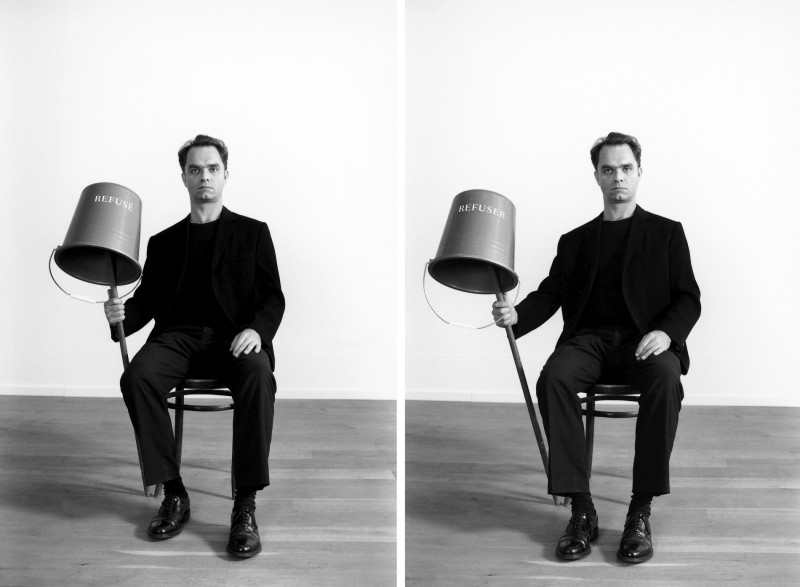
ECRAN I / ECRAN II (2002)
diptych, 2 silver gelatin prints mounted on aluminium, framed, (2x) 60 x 40 cm
FIGURE A / FIGURE B (2002)
diptych, 2 silver gelatin prints mounted on aluminium, framed, (2x) 60 x 40 cm
LA NARRATION (UNE HISTOIRE EXTRAORDINAIRE) (2000) :: text

silver gelatin print mounted on aluminium, framed, 93 x 143 cm

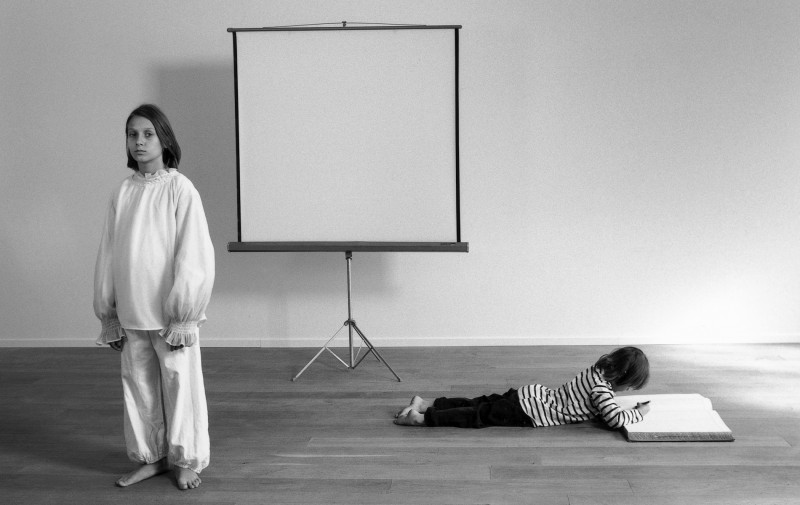
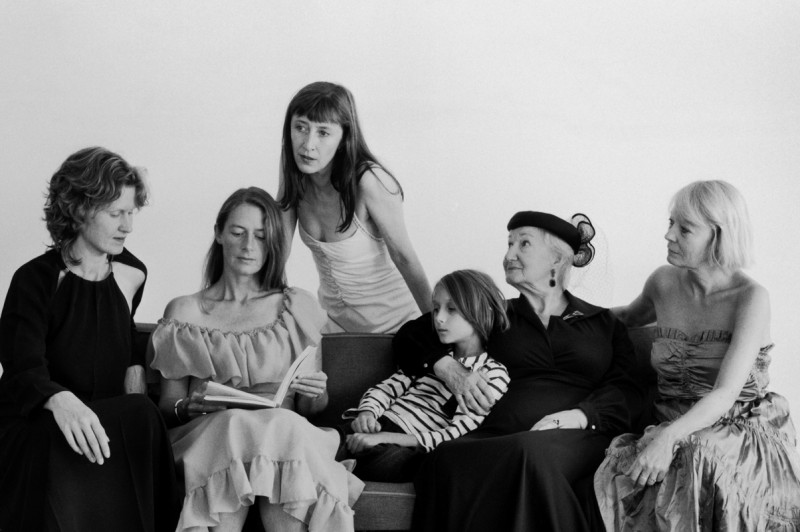
The only thing left that matters then is the storytelling, the ‘narration’ to borrow the term Ana Torfs uses in the title of one of her photographs: La Narration (une histoire extraordinaire) made in 2000. In it, we see an assembly of five women and a child grouped around a book that one of the women (who looks exactly in her middle-age, nel mezzo del cammin di sua vita) is reading to her ‘sisters.’ Those who aspire to reach this hidden point, those who undertake what Kafka called ‘a journey to truth,’ those who still want to be storytellers are wanderers in the night. Homer (often referred to as ‘old Homer’ but who should actually be called the youngest since he fathered all those who came after him) - was blind as was Borges in the end, and the old poet in Wim Wenders' film Der Himmel über Berlin (Wings of Desire, 1987) who wanders from room to angel-haunted room in Berlin's immense library.
(Jean Torrent in: ‘Correspondences’, 2004)

silver gelatin print mounted on aluminium, framed, 93 x 143 cm
L’INTRUSE (2000)
digital print mounted on aluminium, 93 x 140 cm
THE OVAL PORTRAIT (2000) :: text

digital print mounted on aluminium, 93 x 140 cm

The oval portrait initially appears black, but when examined closely, we can just make out the face of a young woman dressed in the Victorian style. In Edgar Allan Poe’s story ‘The Oval Portrait’ (1850), a painter obsessed with producing the most ‘life-like’ portrait possible has his young wife pose for him in a darkened room in a tower for so long that she ends up dying. Ana Torfs has turned that fatal story around for us: it is not the model who has to fade away in the dark (infinite posing was not required - after all, a photograph is made in an instant), but her image that dissolves into the darkness.
(Catherine Robberechts in: ‘Impossible Portraits’, 2002)

digital print mounted on aluminium, 93 x 140 cm
CINOC (2007/2008) :: text images

permanent installation consisting of two white led-displays of 27 x 300 cm, mounted in two stainless-steel containers, covered with toughened black glass, finished on the top with laminated safety glass, computer-controlled animation of 999 ‘forgotten words’
book object on reading stand
set of bookmarks

Cinoc, who was then about fifty, pursued a curious profession. As he said himself, he was a ‘word-killer’: he worked at keeping Larousse dictionaries up to date. But whilst other compilers sought out new words and meanings, his job was to make room for them by eliminating all the words and meanings that had fallen into disuse.
When he retired in nineteen sixty-five, after fifty-three years of scrupulous service, he had disposed of hundreds and thousands of tools, techniques, customs, beliefs, sayings, dishes, games, nick-names, weights and measures; he had wiped dozens of islands, hundreds of cities and rivers, and thousands of townships off the map; he had returned to taxonomic anonymity hundreds of varieties of cattle, species of birds, insects, and snakes, rather special sorts of fish, kinds of crustaceans, slightly dissimilar plants and particular breeds of vegetables and fruit; and cohorts of geographers, missionaries, entomologists, Church Fathers, men of letters, generals, Gods & Demons had been swept by his hand into eternal obscurity. (…) Cinoc read slowly and copied down rare words; gradually his plan began to take shape, and he decided to compile a great dictionary of forgotten words, (…) so as to rescue simple words which still appealed to him. In ten years he gathered more than eight thousand of them, which contain, obscurely, the trace of a story it has now become almost impossible to hand on.
(Georges Perec, ‘Life. A User's Manual,’ 1978)

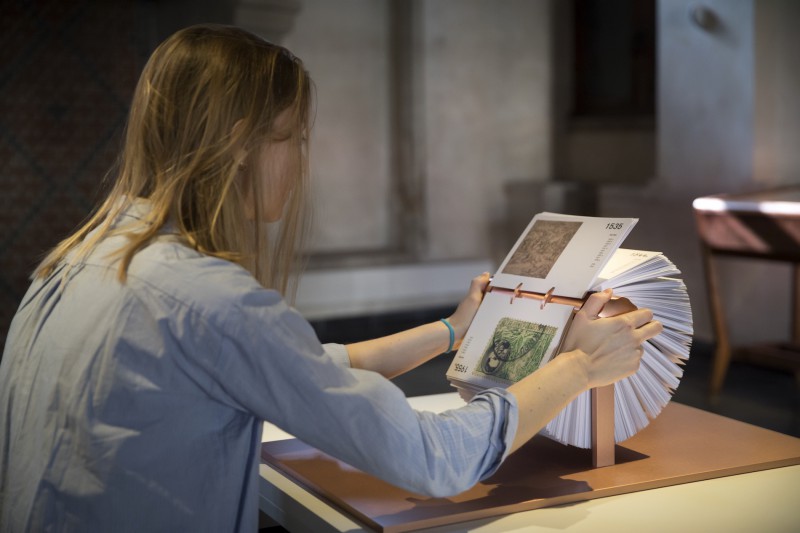
This work, art by assignment, was realized by Torfs at the instigation of the artistic cell of ‘Vlaams Bouwmeester’ (Flemish Government Architect) for a new library in Beveren near Antwerp. It was integrated in front of the two central entrance doors of the building, a design by De Smet-Vermeulen architects. Like in other work by Torfs this permanent installation bears witness of a great predilection for working around language and the construction of meaning. The work was named CINOC, a reference to one of many intriguing characters from a wonderful novel, written in 1978 by the French author Georges Perec: ‘Life: A User’s Manual.’ Cinoc works for the Larousse-encyclopedia as a ‘word killer (‘tueur de mots’). He has to delete words in order to make room for new ones, but he dreams of putting together a dictionary of lost words after his retirement. Like Cinoc, the character from Georges Perec's novel, Ana Torfs set out on a long quest for words that disappeared from the Dutch vocabulary. To this effect she consulted the ‘Nieuw woordenboek der Nederlandsche taal’ (New Dictionary of the Dutch Language) by I.M. Calisch and N.S. Calisch (1864), the forerunner of the ‘Van Dale’ dictionary. From this she selected, after careful consideration, a list of 999 disused nouns like ‘eenschaduwigen’ (‘single-shadowers’, lit.), ‘onderzieltje’ (‘nethersoul’), ‘waargeest’ (‘wanderghost’), gelijkmaker (‘equalizer’), schommeljongen (‘rocking boy’), ‘waterschoenen’ (‘water shoes’), ‘stofvarken’ (‘dust pig’), ‘goudzuiger’ (‘gold sucker’), ‘zeeroeper’ (‘sea-caller’) etc. These words might well have been common 150 years ago, but they are totally forgotten by now. But they might evoke, however, many associations for contemporary readers - often poetical or funny even, since we are no longer familiar with their actual meaning. Words like that juice the imagination.
On entering the library the audience walks over a small glass plate in laminated safety glass. Underneath there is a long led-display, that (re)animates the 999 forgotten words one by one, that brings them back to life. The curious visitor who would like to linger a little longer around one of these words or find out their meaning, can do so in a ‘vergeetwoordenboek’ (‘dictionary of forgotten words’), in which the selected words are printed in alphabetical order, one word on each page. This unique book object of 999 pages lies on a reading stand in the library. As part of this project a series of 30 different bookmarks was printed in an edition of 12.000, a copy of which is being handed out to the audience at each borrowing. On one side of the bookmark you can read the ‘forgotten word’, on the other side you can read its meaning.

some examples of words selected by Torfs and their meaning:
-‘Bijhoed’ (side hat): hat for every-day use, as opposed to Sunday hat.
-‘Eenschaduwigen’ (single-shadowers): inhabitants of moderate climates, where the shadow at noon always falls to a single side, either north or south).
-‘Zeeroeper’ (sea-caller): tool use to converse with one another at sea over large distances.
-‘Waterschoenen’ (water shoes): specific shoes, made of wood, used to walk on the water surface.
-‘Wolkvanger’ (cloud catcher): some kind of sailor's overgarment, to protect them from evil weather.
-‘Onderzieltje’ (nethersoul): petticoat.
-‘Toverformulier’ (magic form): what a magician says before he starts his activities.

MORE LIGHT (2007) :: text images

proposal for a light sculpture in animated white neon letters on the roof of the new campus of Sint Lukas University College for Art & Design in Brussels, designed by Poponcini & Lootens (context of international competition, not selected for execution)

Du mentir-faux
Frac Lorraine Metz, extra muros
(FR, May-September 2012)

2010
ALBUM/TRACKS B
Generali Foundation, Vienna
(AT, September 3-December 12, 2010)

ALBUM/TRACKS A
K21, Kunstsammlung Nordrhein-Westfalen, Düsseldorf
(DE, February 27-July 18, 2010)

2008
ANATOMY
Sprengel Museum, Hannover
(DE, April 13-September 7, 2008)

2007
ANATOMY
argos centre for art and media, Brussels
(BE, February 6-March 10, 2007)

2006
ANATOMY
daadgalerie, Berlin
(DE, September 23-November 4, 2006)

FIGUREN/PROJEKTIONEN 2000-2005
Gesellschaft für Aktuelle Kunst (GAK) Bremen
(DE, January 26-April 27, 2006)

2005
FÜR EISLER
DeSingel, International Arts Campus, Antwerp
(BE, November 8, 2005)

2004
APPROXIMATIONS/CONTRADICTIONS
Dia Art Foundation, New York
(US, web project, launched December 2, 2004)

THE INTRUDER
Roomade, Brussels
(BE, October 15-24, 2004)

2003
“à…à…aaah!” (écrans, Dark Pictures, Redites, Essais de frontispice et autres vignettes)
Het Kabinet, Ghent
(BE, November 22, 2003-January 18, 2004)

2002
ELECTIVE AFFINITIES/THE TRUTH OF MASKS & TABLES OF AFFINITIES
Etablissement d’en face, Brussels
(BE, edition project, September 27-November 11, 2002)

2000
DU MENTIR-FAUX
Palais des Beaux-Arts, Brussels
(BE, September 15-November 5, 2000)

1995
IL COMBATTIMENTO
Theater aan het Spui/Stroom hcbk, Den Haag
(NL, May 9-22, 1995)

1993
IL COMBATTIMENTO
Royal Palace, Antwerp
(BE, Antwerp93, Cultural Capital of Europe, May 21-June 11, 1993)

2012
Manifesta 9, The Deep of the Modern, Genk
(BE, June 1-September 30, 2012, curated by Cuauhtémoc Medina, Katerina Gregos and Dawn Ades)

BOOKSHOWBOOKSHOP, Belgische kunstenaarsboeken van Verheyen tot vandaag
Be-Part, Waregem
(BE, April 15-June 10, 2012, curated by Johan Pas and Vaast Colson)

2011
Big Picture (Zeitzonen/Time Zones)
K21, Kunstsammlung Nordrhein-Westfalen, Düsseldorf
(DE, December 9, 2011- April 1, 2012, curated by Doris Krystof)

Masterpieces in MAS. Five Centuries of Imagery in Antwerp
MAS (Museum aan de Stroom), Antwerp
(BE, May 17, 2011-December 31, 2012, curated by Bart De Baere, Nico Van Hout and Iris Cockelberghs)

2010
ABC-Contemporary Art in Belgium
Le Fresnoy, Studio national des arts contemporains, Tourcoing
(Fr, October 9-December 30, 2010, curated by Dominique Païni, Pascale Pronnier)

Demain vous n'y penserez plus
Galerie Art & Essai, Rennes 
(Fr, April 29-June 6, 2010, curated by Marion Hohlfeldt)

Break Even
International Film Festival Rotterdam
(NL, January 27-February 7, 2010, curated by Edwin Carels)

The State of Things. Brussels/Beijing.
NAMOC, Beijing
(CN, April 30-June 1, 2010, curated by Luc Tuymans, Fan Di'an and Ai Weiwei)

2009
The State of Things. Brussels/Beijing
Bozar, Center for Fine Arts, Brussels
(BE, October 17, 2009-January 10, 2010, curated by Luc Tuymans, Fan Di'an and Ai Weiwei)

Time Festival
Ghent
(BE, November 2009, curated by Els Dietvorst and Dirk Braeckman)

Jeugdzonde / Over opus één en opus min één
Hedah, Centrum voor hedendaagse kunst, Maastricht
(NL, September 5-October 3, 2009, curated by Ulrike Lindmayer)

A Story of the Image
National Museum of Singapore
(SG, August 13-October 31, 2009, curated by  Bart De Baere, Paul Huvenne, Dieter Roelstraete and Herwig Todts)

A Story of the Image
Shanghai Art Museum, Shanghai
(CN, April 30-June 21, 2009, curated by  Bart De Baere, Paul Huvenne, Dieter Roelstraete and Herwig Todts)

Vérité Exposée – About Memory
Ernst Museum/Mucsarnok, Kunsthalle Budapest
(HU, April 10-May 31, 2009, curated by Kati Simon)

Jeugdzonde / Over opus één en opus min één
LLS 387, Ruimte voor actuele kunst, Antwerp 
(BE, March 19-May 30, 2009, curated by Ulrike Lindmayer)

2008
Un Coup de Dés, Writing Turned Image. An Alphabet of Pensive Language
Generali Foundation, Vienna
(AT, September 18-November 23, 2008, curated by Sabine Folie)

Peripheral Vision and Collective Body
Museion, Bolzano
(IT, May 24-September 21, 2008, curated by Corinne Diserens)

2007
Talking Pictures
K21, Düsseldorf
(DE, August 18-November 4, 2007, curated by Doris Krystof)

Projection Project II
Mucsarnok Kunsthalle, Budapest
(HU, June 23-August 26, 2007, curated by Mark Kremer, in collaboration with Edwin Carels, Dieter Roelstraete)

Research and Invention
Fotomuseum, Winterthur
(CH, June 2-August 19, 2007, curated by Thomas Seelig)

A Story of the Image
MuHKA, Antwerp
(BE, June 1-August 19, 2007, curated by Bart De Baere, Dieter Roelstraete and Herwig Todts)

Übergangsräume/Potential Spaces
Württembergischer Kunstverein, Stuttgart
(DE, May 17-August 12, 2007, curated by Hans D. Christ, Iris Dressler)

Borderline Behaviour
tent., Rotterdam
(NL, January 25-March 18, 2007, curated by Edwin Carels)

Time Frames, films by photographers & visual artists
MuHKA_media, Antwerp
(BE, 7, 14, 21, 28 January 2007, curated by Edwin Carels)

2006
Projection Project
MuHKA, Antwerp
(BE, December 15, 2006-February 15, 2007, curated by Mark Kremer, Edwin Carels, Dieter Roelstraete)

Sonambiente II
different venues, Berlin
(DE, June 1-July 16, 2006, curated by Georg Weckwerth)

2005
Photo Based & French Art in the Collection
MuHKA, Antwerp
(BE, September 27-November 13, 2005)

Belgian Photographers 1840-2005
FotoMuseum, Antwerp
(BE, June 24-September 19, 2005, curated by Inge Henneman)

The Web as a Work of Art
Victoria University's Vuspace gallery, Melbourne
(AU, July 20-August 10, 2005, curated by Michelle Mantsio)

Visionary Belgium
Palais des Beaux-Arts, Brussels
(BE, March 4-May 15, 2005, curated by Harald Szeemann)

Screen Tests
Fotomuseum, Rotterdam
(NL, January 22-March 6, 2005, curated by Edwin Carels)

2004
Dedicated to a Proposition
Extra City, Antwerp
(BE, November 20, 2004-February 20, 2005, curated by Wim Peeters)

Nuits d’été
FRAC Lorraine, Metz
(FR, June 11-August 15, 2004, curated by Béatrice Josse)

Duo Track, Language and Image
De Buren, argos extra-muros, Brussels
(BE, June 25-July 11, 2004, curated by Paul Willemsen)

Short Stories
FotoMuseum, Antwerp
(BE, March 20-May 31, 2004, curated by Inge Henneman)

2003
Once upon a Time, a Look at Art in Belgium in the Nineties
MuHKA, Antwerp
(BE, December 20, 2003-February 29, 2004, curated by Guillaume Bijl)

Réalités, Collections without Frontiers II
Zacheta National Gallery of Art, Warsaw
(PO, September 15-November 16, 2003, curated by Agnieszka Morawinska, Hanna Wroblewska)

2002
ForwArt, a Choice
different venues, Brussels
(BE, September 27-November 11, 2002, curated by Lynne Cooke, Chris Dercon, Robert Fleck, Hans-Ulrich Obrist)

Uncertain Signs-True Stories
Badischer Kunstverein, Karlsruhe
(DE, April 21-June 16, 2002, curated by Angelika Stepken)

Film Festival of the European Union
different venues, Praha/Brno
(CZ, March 7-26, 2002)

2001
9th Biennial of Moving Images
Centre pour l’Image Contemporaine Saint-Gervais, Geneva
(CH, November 2-11, 2001)

Ciphers & Letters
hARTware, Dortmund
(DE, March 2-April 8, 2001, curated by Iris Dressler, Hans D. Christ)

Exploding Cinema, Cinema without Walls
Museum Boijmans van Beuningen, Rotterdam
(NL, January 24-February 4, 2001, curated by Chris Dercon)

Magnetic North
Walker Art Center, Minneapolis
(US, October 2000, curated by Jenny Lion)

2000
9e Festival Filmer à Tout Prix, Cinéma des Réalités
different venues, Brussels
(BE, November 21-30, 2000)

International Festival Filmforum Arsenals
different venues, Riga
(LV, September 16-24, 2000)

Tous le temps/Every Time, La Biennale de Montreal
Palais du Commerce, Montreal
(CA, September 28-October 29, 2000, curated by Peggy Gale)

1999
13e Rencontres Cinématographiques, une Certaine Idée du Cinéma
Fresnoy Studio National des Arts Contemporains, Tourcoing
(FR, December 3-12, 1999, curated by Jacques Déniel)

Belluard Bollwerk International
different venues, Fribourg
(CH, June 25-July 10, 1999, curated by Cis Bierinckx)

23th International Film Festival of Sao Paulo
(BR, October 15-28, 1999)

4th International Festival of New Film, Split
(HR, September 25-October 2, 1999)

5th Viewpoint Film Festival, Ghent
(BE, March 3-10, 1999, curated by Cis Bierinckx)

28th International Film Festival, Rotterdam
(NL, January 27-February 7, 1999, curated by Simon Field)

Zyklus von Kleinigkeiten’, Austrian premiere
Filmcasino, Vienna
March 1999

1998
The Art of Trying
Cinemateca Portugesa, Lisbon
(PT, September 24-October 1, 1998, curated by Edwin Carels)

Schieve Cinema No. 7, Boris Lehman & Ana Torfs
Cinema Nova, Brussels
(BE, September 22-23, 1998)

5th KunstenFestivaldesArts
different venues, Brussels
(BE, May 9-30, 1998, curated by Frie Leysen)

Festival aan de Werf
different venues, Utrecht
(BE, May 22-31, 1998)

1997
Inside the Visible
Art Gallery of Western Australia, Perth
(AU, February 16-April 6, 1997, curated by Catherine de Zegher)

1996
5e Biennale Internationale du Film sur l’Art
Centre Pompidou, Paris
(FR, October 16-21, 1996)

Sonambiente I
different venues, Berlin
(DE, August 9-September 8, 1996, curated by Georg Weckwerth)

Inside the Visible
The Institute of Contemporary Art, Boston
(US, January 31-May 12, 1996, curated by Catherine de Zegher)

Transvisionen
Foro Artistico, Hannover
(DE, January 12-February 4, 1996, curated by Axel Bohse)

1995
3e Biennale d’Art Contemporain de Lyon
(FR, December 20, 1995-February 18, 1996, curated by Thierry Prat, Thierry Raspail, Georges Rey)

6th International Video Week
Centre pour l’Image Contemporaine Saint-Gervais, Geneva
(CH, November 3-11, 1995)

Viper, International Festival for Film, Video and New Media
different venues, Luzern
(CH, October 25-29, 1995, curated by Conny E. Voester)

Bruxelles-Genève
Centre pour l’Image Contemporaine Saint-Gervais, Geneva
(CH, April 26-June 2, 1995)

Kinekunst I
Casino, Knokke
(BE, May 24-27, 1995)

IMZ Opera Screen
Opera National de Lyon
(FR, June 1995)

1994
18th Festival International du Film d’Art
Maison de l’Unesco, Paris
(FR, November 17-29, 1994)

Prix de la jeune peinture belge
Palais des Beaux-Arts, Brussels
(BE, September 9-November 9, 1994)

6th Videonale
Bonner Kunstverein, Bonn
(DE, September 14-18, 1994

15th Video Art Festival
different venues, Locarno
(CH, September 1994)

International Filmfestival of Brussels
different venues, Brussels
(BE, January 12-24, 1994)

1993
Film+Arc 1
different venues, Graz
(AT, December 2-5, 1993)

5th International Video Week
Centre pour l’Image Contemporaine Saint-Gervais, Geneva
(CH, October 29-November 6, 1993)

IMZ Dance Screen
Alte Oper, Frankfurt
(DE, June 1993)


Distant Voices, Distant Views, Kassandra Nakas, 2011

Ghosts, or On the Beauty of Plants and their Names in Times of Ignorance in Ana Torfs’ "Family Plots", Gabriele Mackert, 2011

Interview Ana Torfs with Lothar Frangenberg, 2010

Displacement, Catherine Robberechts, 2009

Interview Ana Torfs with Els Roelandt, 2006

Ana Torfs in daadgalerie, Jennifer Allen, Artforum, 2006

The World Observer, Gabriele Mackert, GAK, Bremen, 2006

Reading as a Form of Writing, Dirk Lauwaert, A Prior Magazine, 2004

Correspondences, Jean Torrent, A Prior Magazine, 2004

Approximations/Contradictions, Sara Tucker for Dia Art Foundation, 2004

Du mentir-faux, Catherine Robberechts, Frac Lorraine-catalogue of the collection, Metz, 2002
ALBUM/TRACKS A + B :: text images

Generali Foundation, Kunstsammlung Nordrhein-Westfalen, Verlag für moderne Kunst, Nürnberg, 2010
204 p., more than 200 color and black-and-white illustrations, hard cover, 285 x 220 mm
German/English
ISBN 978-3-86984-015-4
graphic design: N.N. (Jurgen Persijn)

ALBUM/TRACKS A+B is the title of the comprehensive publication accompanying Ana Torfs’ solo exhibitions in K21, Düsseldorf and Generali Foundation, Vienna, which the artist conceived in collaboration with the curators. The book, congenially designed by Jurgen Persijn, comprehensively documents Torfs’ œuvre between 1993 and 2010, with deliberately brief and subjective remarks about each individual work from multiple critical voices such as Mieke Bal, Michael Glasmeier, Sabine Folie, Anselm Franke, Doris Krystof, Steven Jacobs, Gabriele Mackert, Friedrich Meschede, and Catherine Robberechts. An introductory essay by Kassandra Nakas and a correspondence between Gabriele Mackert and the artist complete the wide spectrum of perspectives on Torfs’ work.

For more information about this publication: Verlag für moderne Kunst Nürnberg

Contents:
Kassandra Nakas: Beauty in Doubt. On Ana Torfs’ Work with Pictures and Texts
Sabine Folie: A Sentimental Journey to the North
Anselm Franke: Missing Bodies
Catherine Robberechts: Out of the Picture
Doris Krystof: Elegies on the World Wide Web
Gabriele Mackert: Images of Condensed Rhetoric
Friedrich Meschede: Elective Metamorphoses
Mieke Bal: Intertwined Dualities
Steven Jacobs: A Conversation Piece
Michael Glasmeier: Sound, Body, Language
Gabriele Mackert, Ana Torfs: “Never Trust the Artist, Trust the Tale.” An Email Correspondence

ANATOMY :: text images

Berliner Künstlerprogramm, DAAD, Berlin, 2006
64 p., ill., hard cover, 305 x 210 mm
German/English
ISBN 3-89357-115-9
graphic design: N.N. (Jurgen Persijn) and Ana Torfs

publication issued by the Berlin artists-in-residence-program DAAD in conjunction with the first exhibition of Ana Torfs’ installation ANATOMY at daadgalerie, Berlin, September 23 through November 4, 2006

During her scholarship as a DAAD artist-in-residence in 2005/2006 Ana Torfs researched in the Freiburg Military Archive on a trial held in May 1919, the ‘Case of the Murder of Dr. Karl Liebknecht and Rosa Luxemburg before the Military Field Tribunal of the Cavalry Guard Rifle Division in the Main Courtroom at the Berlin Criminal Court’. Ana Torfs pinpointed selected statements from this trial to compose ‘A Tragedy in Two Acts,’ the literary script for her installation. She gave the project the ambiguous title ANATOMY. The absurd show trial of Luxemburg and Liebknecht’s murderers includes a considerable amount of harrowing detail on how the murders were actually committed. The case files have been divided up by Torfs into short scenes so that a tragic story emerges in which details from the same event are told from different angles, highlighting the relative nature of the narrative. The focus is on language, and of course language is never objective… The book, which is a fascinating ‘translation’ of the installation, contains text and photography by Torfs including the ‘Tragedy in Two Acts’ and besides a personal text about the creation process of the installation.

FIGURES/PROJECTIONS 2000-2005 :: text images

Gesellschaft für aktuelle Kunst (GAK) Bremen, 2006
112 p., ill., soft cover, 175 x 100 mm
German/English
ISBN 3-926865-30-X
graphic design: N.N. (Jurgen Persijn) and Ana Torfs

Publication issued on the occasion of Ana Torfs’ exhibition FIGUREN/PROJEKTIONEN 2000-2005
at the Gesellschaft für Aktuelle Kunst (GAK) Bremen, January 27 through April 23, 2006

On the occasion of Torfs’ solo exhibition in Bremen, the Gesellschaft für aktuelle Kunst (GAK) issued this bilingual reader with essays by Dirk Lauwaert, Gabriele Mackert, Catherine Robberechts and Jean Torrent. Though this booklet counts 112 pages, it looks like a tiny brochure by opting for very thin paper. The booklet contains a German and an English section, symmetrically starting on both sides of the booklet, by simply flipping it upside down. We tried to make an attractive booklet with introductory essays about the works in the exhibition, for a very low cost.

A PRIOR MAGAZINE #10 :: text images

vzw Mark, Brussels, October 2004
280 p., ill. cover ill., soft cover, 235 x 170 mm
English + Dutch/French appendixes
graphic design: N.N. (Jurgen Persijn)

publication launched on
October 14, 2004, roomade, Brussels
December 2, 2004, Dia Art Foundation, New York

A PRIOR MAGAZINE #10 is the first publication introducing Torfs’ versatile work during the 1993-2003 period. Essays by Jean Torrent, Dirk Lauwaert and Dirk Pültau are published in English, Dutch and French. Over the past 10 years Torfs’ work developed into a self-willed œuvre attracting more and more interest, also on an international scale. Ana Torfs investigates, among other things, the issue of the portrait. The relationship between text and image, between reading and representing, is brought up again and again in, among others, a 35 mm film, photo series, a video installation, various slide projection installations and autonomous artist’s publications. In A PRIOR MAGAZINE #10 Torfs presents an extensive visual portfolio, counting over 100 pages, covering her works IL COMBATTIMENTO (1993), ZYKLUS VON KLEINIGKEITEN (1998), DU MENTIR-FAUX (2000), ELECTIVE AFFINITIES/THE TRUTH OF MASKS & TABLES OF AFFINITIES (2002) and “à…à…aaah!” (2003). Additionally three authors elaborate on various aspects of her multi-layered body of work: in a wonderful literary text Jean Torrent outlines a number of mutual relations, ‘Correspondences’, between Torfs’ work and unnoticed relationships, unheard correspondences and new stories paired off with them by the author; Dirk Lauwaert approaches Torfs’ ‘Working with Texts’ in a very concise and refined text; and in ‘The Blind Singer and the Absent Composer’ Dirk Pültau analyses the use of music, voice and the interdisciplinary in two works by Torfs.
Ana Torfs is more than the central artist in the 10th issue of A PRIOR MAGAZINE. She also took up the part of guest curator for the magazine inviting Belgian artist Franciska Lambrechts (b.1967). With ‘Identity Crisis’ Lambrechts presents a new artist’s project. From the work of Belgian author Daniel Robberechts (b.1937), who passed away in 1992, Torfs opted for a thus far unpublished journal fragment from 1969.
(Els Roelandt’s editorial to the issue)

ELECTIVE AFFINITIES/THE TRUTH OF MASKS & TABLES OF AFFINITIES :: text images

Ana Torfs & Etablissement d’en face projects, Brussels, 2002
7 uncut quires of 16 illustrated pages, printed on Primacoat, 350 x 255 mm
English
graphic design: N.N. (Jurgen Persijn) and Ana Torfs

extra edition issued by Ana Torfs and Etablissement d’en face projects in conjunction with the first exhibition of Torfs’ installation ELECTIVE AFFINITIES/THE TRUTH OF MASKS & TABLES OF AFFINITIES at the Royal Library in Brussels in the context of ‘ForwArt, a Choice’, September 27 through November 11, 2002

This extra edition was made by Ana Torfs in 2002, in close collaboration with graphic designer Jurgen Persijn. ELECTIVE AFFINITIES/THE TRUTH OF MASKS & TABLES OF AFFINITIES is first of all the title of a complex installation: two slide series projected in large format - a seemingly infinite masquerade of two models - and unfolded sheets (70 x 100 cm) on reading tables. Torfs presented this work for the first time during ForwArt, an exhibition organized by ING bank in 2002 at different venues in Brussels. In this installation text and image - as happens more often in Torfs’ œuvre - take up an equal place. During a visit to the exhibition space, Torfs´ text was discovered freely and in fragments, glances passing criss-cross over the text fragments and photos on the reading tables. During the seven weeks the ForwArt exhibition was held, Etablissements d’en face projects made the production of an extra edition possible. Sheets had been printed on wafer-thin paper and folded into quires. Evere week one uncut quire was sent to a limited number of national and international destinations. After having the folds of the leaves slit, it allowed a chronological reading of the text as a whole, as a second stage of Torfs’ ‘book-in-the-making’.* ‘A sort of reading diary, in which the artist combines excerpts from various literary, (auto)biographical and historical works in a very free and associative manner. Some quotes stand out because of a general, almost programmed value: reflections on the “method” Ana Torfs used (working via association and suggestion, following affinities and congruities rather than a close-knit, rational structure) or - more broadly - ideas about what a work of art is or should be. At first the anthology seems to be very loosely structured, the result of free association, of browsing through a poorly organized quantity of data. The link between one extract and the next sometimes lies in a single word. Yet this is clearly not a document, but a carefully composed entity - a work in its own right, also an image in its own right. So the labyrinthian character of the text should not mislead: the web that Torfs spins is not an arbitrary or take-it-or-leave-it construction. The great majority of the excerpts collected by Ana Torfs are about the political history of Europe in the nineteenth and twentieth centuries: stories, testimonies and opinions about wars, persecution, exile and the like. A futile attempt to learn something about the origin of the injustice and the violence that confront us on a daily basis through ordering historical questions and collecting memories; or to learn something from those who tried to make a stand against the perversity of history, sometimes just through their thinking and writing.’**

* Torfs also made a limited deluxe edition. So this ‘book-in-the-making’ has taken up 3 different forms.
** Catherine Robberechts in ‘ForwArt, a Choice,’ 2002

ELECTIVE AFFINITIES/THE TRUTH OF MASKS & TABLES OF AFFINITIES (limited edition) :: text images

Ana Torfs, Brussels, 2002
limited edition of 30 copies, numbered and signed by the artist
7 clean-cut quires of 16 illustrated pages, printed on Freelife Vellum, cardboard boxes, 345 x 225 mm
English
graphic design: Jurgen Persijn and Ana Torfs

limited edition issued by Ana Torfs in conjunction with the first exhibition of her installation ELECTIVE AFFINITIES/THE TRUTH OF MASKS & TABLES OF AFFINITIES at the Royal Library in Brussels in the context of ‘ForwArt, a Choice’, September 27 through November 11, 2002

This limited edition, a ‘text object’, was made by Ana Torfs in 2002, in close collaboration with graphic designer Jurgen Persijn. ELECTIVE AFFINITIES/THE TRUTH OF MASKS & TABLES OF AFFINITIES is first of all the title of a complex installation: two slide series projected in large format - a seemingly infinite masquerade of two models - and unfolded sheets (70 x 100 cm) on reading tables. Torfs presented this work for the first time during ForwArt, an exhibition organized by ING bank in 2002 at different venues in Brussels. In this installation text and image - as happens more often in Torfs’ œuvre - take up an equal place. During a visit to the exhibition space, Torfs´ text was discovered freely and in fragments, glances passing criss-cross over the text fragments and photos on the reading tables. This luxury edition - the clean-cut sheets have been folded into quires and packed into beautifully designed boxes - allows a chronological reading of the text as a whole, as a third stage of this ‘book-in-the-making’.* ‘A sort of reading diary, in which the artist combines excerpts from various literary, (auto)biographical and historical works in a very free and associative manner. Some quotes stand out because of a general, almost programmed value: reflections on the “method” Ana Torfs used (working via association and suggestion, following affinities and congruities rather than a close-knit, rational structure) or - more broadly - ideas about what a work of art is or should be. At first the anthology seems to be very loosely structured, the result of free association, of browsing through a poorly organized quantity of data. The link between one extract and the next sometimes lies in a single word. Yet this is clearly not a document, but a carefully composed entity - a work in its own right, also an image in its own right. So the labyrinthian character of the text should not mislead: the web that Torfs spins is not an arbitrary or take-it-or-leave-it construction. The great majority of the excerpts collected by Ana Torfs are about the political history of Europe in the nineteenth and twentieth centuries: stories, testimonies and opinions about wars, persecution, exile and the like. A futile attempt to learn something about the origin of the injustice and the violence that confront us on a daily basis through ordering historical questions and collecting memories; or to learn something from those who tried to make a stand against the perversity of history, sometimes just through their thinking and writing.**

* Torfs also made an extra edtion, in collaboration with Etablissement d’en face projects, Brussels. So this ‘book-in-the-making’ has taken up 3 different forms.
** Catherine Robberechts in ‘ForwART, a Choice,’ 2002

DU MENTIR-FAUX :: text images

Société des Expositions du Palais des Beaux-Arts, Brussels, 2000
124 p., ill., hard cover, 300 x 205 mm
French/Dutch/English
ISBN 90-74816-24-X
graphic design: Filiep Tacq and Ana Torfs

publication issued on the occasion of the first exhibition of Ana Torfs’ installation DU MENTIR-FAUX at the Palais des Beaux-Arts, Brussels, September 15 through November 5, 2000

When we think of Joan of Arc we might think of an androgynous heroine, Dreyer's and Bresson's marvellous films, the terror of interrogation, a tormented body, a fraught symbol... But what happens when an artist with all this at the back of her mind takes a fresh look at the historical sources? What images do they conjure up? Ana Torfs shows us in the installation DU MENTIR-FAUX (About Lying Falsehood) - of which this book is part. It shows her profound engagement with this historical, mythical and literary figure. The book, with an introductory essay by estimated Belgian film and photography critic Dirk Lauwaert, comprises, apart from a selection by Torfs from these trial reports, an autobiographical text by her own hand, in which she bears witness of her fascination for the figure of Joan of Arc: not as the political or national symbol, but rather as the all too physical, self-willed yet ultimately defenceless victim of an all powerful system. Particularly interesting is the graphic design Torfs chose for her text: in accordance with medieval manuscripts the core text, Torfs’ account of how the work was established and how this process relates to her personal history, shows added ‘glosses’ in a smaller typeface. The relationship between both ‘trails,’ however, is not quite as one would expect. In this case it is not only the author herself who makes ‘comments’ on her own text: the intimate main text can be perceived just as easily to be ‘comment’ or ‘interpretation’ as its surrounding glosses, which in fact deliver more factual information. The more the reader moves back and forth between both trails, the more he or she will be awakened to the fact that any outright attempt at ‘interpretation’ of ‘facts’ can do nothing but founder. Joan of Arc appears as the constantly receding focal point of an inextricable tangle of accounts, testimonials and biased interpretations, out of which no ‘truth’ can be deduced.
(Catherine Robberechts)

BEETHOVEN’S NEPHEW :: text images

Yves Gevaert publisher, Brussels, 1999
166 p., ill., hard cover, 242 x 200 mm
French/English/Dutch/German
ISBN 2-930128-11-9
graphic design: Filiep Tacq and Ana Torfs

book launched on December 14, 1999 at the Palais des Beaux-Arts, Brussels

in 1998 Ana Torfs made the feature film ZYKLUS VON KLEINIGKEITEN (Cycle of Trifles). For this work she drew upon Ludwig Van Beethoven’s so-called ‘conversation books’. These allowed others to ‘talk’ to the famous composer after his hearing deteriorated dramatically in 1818, at the age of 48. Visitors had to make themselves intelligible by writing in small notebooks Beethoven always carried with him until his death in 1827. The conversation books contain the words that were literally addressed to the deaf composer during some of the most important phases of his last years: they conserve as it were what happened all around him. ZYKLUS VON KLEINIGKEITEN provides an insight, albeit literally one-sided, into Beethoven’s everyday life, through very stylised and timeless black and white scenes. While the film was being made, photos were taken with a view to compiling a book. BEETHOVEN’S NEPHEW is not a film’s book, but an artist’s book in its own right.

2012
Ana Torfs in conversation with Samuel Korn in:
Displayer 04 (DE)
Staatliche Hochschule für Gestaltung, pp. 61-76, image portfolio pp 77-112

2011
Lauwaert, Dirk, 'Lezen als een vorm van schrijven. Over de teksten in het werk van Ana Torfs', in:
Onrust
Het balanseer, Gent, pp. 97-110

T' Syen, Jolien, Het kritisch potentieel in het werk van de Belgische kunstenares Ana Torfs
Masterproef Faculteit Letteren (onuitgegeven)
KU. Leuven

Judy Radul, Marit Paasche (ed.)
A Thousand Eyes: Media Technology, Law and Aesthetics
Sternberg Press, 2011, pp. 252-255, ill.

Pirotte, Philippe, 'A Story about Images that Wish to Stand Still', in:
Image-Thinking, Five Centuries of Images in Antwerp
Bart De Baere / Nico Van Hout / Iris Cockelberghs (ed.)
MAS BOOKS, Antwerp, 2011, pp 218-221, pp. 154-155, ill.

Krystof, Doris, "'Der Eindringling' - Raum und Theatralität in den Projektionen von Ana Torfs", in: 
Frohne, Ursula & Haberer Lilian (ed.)
Kinematografische Räume, Installationsästhetik in Film und Kunst
Wilhelm Fink Verlag, Munich

2010
Bal, Mieke, 'True Lies: on Ana Torfs’ "Du mentir-faux", or Some Dilemmas of History', in:
Ottosen, Rune & Steigen, Solveig (ed.)
HiO-report 12: Framing War with Facts and Fiction in the Cultural Field
Oslo University College, Oslo, 2010

Urban, Annette, ‘Displacement’, in:
Nierhaus, Irene / Hoenes, Josh / Urban, Annette (ed.)
Landschaftlichkeit zwischen Kunst, Architektur und Theorie
Reimer Verlag, Berlin, 2010

Nakas, Kassandra, ‘Un-Sentimental Journeys. Exploring ‘Space’ in Ana Torfs’ Work’, in: 
Van Damme, Claire (ed.)
Invitation au voyage
Academia Press, Ghent, 2010

2009
Lauwaert, Dirk, ‘The Intruder’, in: 
The State of Things, Brussels/Beijing
Tuymans, Luc / Di'an, Fan / Weiwei, Ai & Pirotte, Philippe (ed.)
Bozar/lannoo, Brussels/Tielt, pp. 168-169, ill.
(exh.cat.)

Braeckman, Dirk / Dietvorst, Els (ed.)
TIMEbook
vzw Time Festival, Ghent, 2009, pp. 18-15, 302-303, ill.

Pirotte, Philippe, ‘A Story about Images that Wish to Stand Still’, in:
De Baere, Bart (ed.)
A Story of the Image
vzw Museums and Heritage, Antwerp, 2009
(exh.cat.)

Simon, Kati (ed.)
Vérité exposée-About Memory
Ernst Museum/Mucsarnok Kunsthalle, Budapest, 2009
(exh.brochure)

2008
De Wit, Dirk/ Judong, Anne (ed.)
art flanders 08, visual arts
BAM, Ghent, 2008

Grosenick, Uta / Seelig, Thomas (ed.)
Photoart: Photography in the 21st Century
Aperture, New York, 2008, pp. 434-437, ill.

Collection of Flemish Community Acquisitions, 2002-2006
Flemish Authorities, Brussels, 2008, pp. 120, 153, 310, 382-383, ill.

Robberechts, Catherine, ‘Du mentir-faux, Ana Torfs’, in:
De Wim Delvoye à Francis Alÿs, coll. ‘500 chefs-d’œuvre de l’art belge’
Racine, Brussels, 2008, p. 54-55, ill.

Lauwaert, Dirk, ‘The Intruder’, in:
Folie, Sabine (ed.)
Un coup de dés, Writing Turned Image. An Alphabet of Pensive Language
Generali Foundation, Vienna/Verlag Walther König, Köln, 2008, pp. 184-189, ill.
(exh.cat.)

Diserens, Corinne (ed.)
Peripheral Vision and Collective Body
Museion, Bolzano, 2008, pp. 80-81, ill.
(exh.cat.)

Grosenick, Uta / Seelig, Thomas (ed.)
Photoart: The New World of Photography
Thames and Hudson, London, 2008, pp. 434-437, ill.

Vorkoeper, Ute, ‘Mitwirkung am Politischen. Über Zeugenschaft und Dauer von zeitgenössischer Kunst’, in:
Ott, Michaela / Strauss, Harald (ed.)
Ästhetik + Politik. Neuaufteilungen des Sinnlichen in der Kunst
Schriftenreihe der HfbK Hamburg/Textem Verlag, 2008

Glasmeier, Michael, ‘Stimme, Stimmung, Stimmen. Kunsthistorische Aspekte zu Momenten bei Ana Torfs’, in:
Glasmeier, Michael
Das Ganze in Bewegung. Essays zu einer Kunstgeschichte des Gegenwärtigen
Philo Fine Arts, Fundus, Hamburg 2008

2007
Eelbode, Erik, ‘Ana Torfs’, in:
Grosenick, Uta / Seelig, Thomas (ed.)
Photo Art, Fotografie im 21 Jahrhundert
DuMont Verlag, Köln, 2007, pp. 434-437, ill.

Roelstraete, Dieter (ed.)
Jubilee, MuHKA 2007/1987/1967
MuHKA, Antwerp, 2007, pp. 270, 274-275, ill.

Robberechts, Catherine, ‘Du mentir-faux, Ana Torfs’, in:
Actuele Kunst van Wim Delvoye tot Luc Tuymans, coll. ‘600 jaar Belgische Kunst in 500 kunstwerken’
Standaard Uitgeverij/Lannoo, Antwerp, 2007, pp. 82-83, ill.

Krystof, Doris, ‘The Intruder’, Ana Torfs’ in:
Krystof, Doris / Scheuermann, Barbara (ed.)
Talking Pictures
DuMont Verlag, Köln, 2007, pp. 89-96, ill. + text of Torfs’ adaptation of Maeterlinck’s play. pp. 97-112
(exh.cat.)

Seelig, Thomas, ‘Du mentir-faux’ in:
Seelig, Thomas (ed.)
Research and Invention
Scheidegger & Spiess Verlag, Zürich, 2007, p.120, pp. 44-53, portfolio
(exh.cat.)

Laenen, Katrien (ed.)
Kunst in opdracht 1999-2005
Vlaams Bouwmeester, Brussels, 2007, pp. 292-293.

2006
Carels, Edwin / Kremer, Marc / Roelstraete, Dieter (ed.)
Projectie: Technologie als Metafoor
Nai uitgevers, Amsterdam, 2006, ill. p. 64 and cover ill.
(exh.cat.)

Pauleit, Winfried, ‘Kino/Museum, Film als Sammlungsobjekt oder Film als Verbindung von Archiv und Leben’ in:
Viktor Kittlausz / Winfried Pauleit (ed.)
Kunst - Museum - Kontexte. Perspektiven der Kunst- und Kulturvermittlung
Transcript Verlag, Bielefeld, 2006, pp. 113-135, ill.

Robberechts, Catherine, ‘Du mentir-faux’, in:
Josse, Béatrice / Guénin, Hélène (ed.)
IN/VISIBLE, collection/productions FRAC Lorraine
JRP/RINGIER, Zürich, 2006, pp. 184-185, ill.

Weckwerth, George (ed.)
Sonambiente
Kehrer Verlag, Heidelberg, 2006, pp. 130-131, 398, ill.
(exh.cat.)

2005
Torfs, Ana, Für Eisler
DeSingel, International Arts Campus, 2005, Antwerp, 28 p.
(brochure)

De Baere, Bart / Bounameaux, Henry (ed.)
Contemporary Art in Belgium II
Best of Publishing, Brussels, 2005, pp. 214-217, ill.

Henneman, Inge, ‘Ana Torfs’, in:
Belgische Fotografen 1840-2005
Ludion, Ghent, 2005, pp. 282-283 ill.

Swinnen, Johan, ‘Ana Torfs, de geordende chaos’, in:
De lichte kamer. De onverborgen fotografie
Garant, Antwerp, 2005, pp. 91-92, 98, ill.

Fonds Mercator/Palais des Beaux-Arts (ed.)
La Belgique Visionnaire, Harald Szeemann
Mercator Fonds, Antwerp, 2005
(exh.cat.)

2004
Peeters, Wim (ed.)
Dedicated to a Proposition, New and existing projects by 18 artists
extra edition of De Tijd, Antwerp, 2004, 8 p., ill.
(exh.brochure)

2003
Robberechts, Catherine, ‘Du mentir-faux’, in:
Agnieszka Morawinska / Hanna Wroblewska (ed.)
Réalités
Zacheta National Gallery, Warsaw, 2003, pp. 125-130, ill.
(exh.cat.)

Peeters, Wim, ‘Un négatif de l’histoire’, in:
Decennium, l’art belge et l’après Documenta IX
Ludion/Cera Foundation, Ghent, 2003, pp. 10-11, 30-33, ill.

2002
Robberechts, Catherine, ‘Elective Affinities/The Truth of Masks & Tables of Affinities’, in:
ForwArt, a Choice
ING, Brussels, 2002, pp. 172-181, ill.
(exh.cat.)

Robberechts, Catherine, ‘Impossible Portraits’, in:
Stepken, Angelika (ed.)
Uncertain Signs-True Stories
Badischer Kunstverein, Karslruhe, 2002, ill.
(exh.cat.)

2001
Bex, Florent
Kunst in België na 1975
Mercatorfonds, Antwerp, 2001, pp. 161, 348, 398, ill.

Dressler, Iris, ‘Du mentir-faux’, in:
Dressler, Iris / Christ, Hans D. (ed.)
Hartware 2001
Hartware MedienKunstVerein, Dortmund, 2001, pp. 17-18, 85, ill.
(exh.cat.)

Huber, Gauthier, ‘Esthétique du déplacement’, in:
Bonvin, Laurence / Zürcher, Sarah (ed.)
9th Biennial of Moving Images
Centre pour l’Image Contemporaine Saint-Gervais, Geneva, 2001, pp. 114-117, 173, ill.
(exh.cat.)

2000
Gale, Peggy, ‘Du mentir-faux’, in:
Tous le Temps/Every Time, La Biennale de Montreal
CIAC, Montreal, 2000, pp. 138-143, ill.
(exh.cat.)

Lion, Jenny, (ed.)
Magnetic North
University of Minnesota Press, Mineapolis, 2000, pp. 106-109, ill.
(exh.cat.)

1998
Dumont, Isabelle, ‘Zyklus von Kleinigkeiten’, in:
5th KunstenFestivaldesArts
Brussels, 1998, file No. 18, ill.
(exh.cat.)

1996
Weckwerth, Georg (ed.)
Klangkunst
Prestel Verlag, Munich, 1996, pp. 144-145, ill.
(exh.cat.)

Carels, Edwin, ‘Cultivated want’, in:
De Zegher, Catherine (ed.)
Inside the visible
MIT press, Cambridge, 1996, pp. 192-197, ill.
(exh.cat.)

1995
Prat, Thierry / Raspail, Thierry / Rey, Georges (ed.)
3e Biennale d’Art Contemporain de Lyon
Réunion des Musées Nationaux, Paris, 1995, pp. 286, 354—357, ill.
(exh.cat. + CD-ROM)

1994
Baudson, Michel (ed.)
Prix de la jeune peinture belge
Fonds Mercator Paribas, Antwerp, 1994, pp. 54-55, ill.
(exh.cat.)
2012
Ana Torfs in conversation with Samuel Korn in:
Displayer 04 (DE)
Staatliche Hochschule für Gestaltung, pp. 61-76, image portfolio pp 77-112

2011
Wittockx, Eva
'Best of 2011', in:
Metropolis M #6 (NL)
December 2011/January 2012, p. 23

Kassandra Nakas
'Distant Voices, Distant Views'

Helen Chang
'Ana Torfs in Generali Foundation', in:
Frieze
March 2011, nr 137

Mackert, Gabriele
'Ghosts, or On the Beauty of Plants and their Names in Times of Ignorance in Ana Torfs’ “Family Plots"'

2010
Bal, Mieke
‘Displacements’, lecture
Generali Foundation, Vienna (AT)
December 2, 2010

Sandqvist, Gertrud
What is Truth: on the Complications of Personal Judgement in the Work of Ana Torfs’, lecture in the context of Vienna Art Week
Generali Foundation, Vienna (AT)
November 18, 2010

Pfaffenbichler, Norbert
ALBUM/TRACKS B, Ana Torfs in Generali Foundation’, in:
Springerin (AT)
October 2010, Heft 4, ill.

Probst, Ursula Maria
Never Trust the Artist, Trust the Tale’, in:
Spike Magazine (AT)
October 2010, issue nr 25, pp 131-132, ill.

Schwanberg, Johanna
Unersetzbare kunstlerische Sprache’, in:
Die Furche (AT)
14/10/2010, ill.

Borchardt-Birmbaumer, Brigitte
Vielstimmige Bild-Elegien’, in:
Wiener Zeitung (AT)
30/9/2010, p. 14, ill.

Huber, Michael
Die Abgrunde des Nikotins und andere Geschichten von Ana Torfs’, in:
Kurier (AT)
15/9/2010, Ill

Vogel B. Sabine
ALBUM/TRACKS B in Generali Foundation’, in:
Die Presse (AT)
6/9/2010, Ill.

Feßler, Anne Katrin 
Sezieren von Geschichte’, in:
Der Standard (AT)
8/9/2010, Ill.

Schedlmayer, Nina
‘ALBUM/TRACKS B in Generali Foundation’, in:
Profil (AT)
3/9/2010, Ill.

Jacobs, Steven
‘Introduction to screening of “Zyklus von Kleinigkeiten”’, lecture
Filmcasino, Vienna
September 3, 2010

Prawda, Angelika
ALBUM/TRACKS B in Generali Foundation’, in: 
Der Standard (AT)
2/9/2010, Ill

Delbecque, Camille
ALBUM/TRACKS A’, in:
Vocatio (BE)
August 2010, nr 37, pp. 14-18, Ill.

Hohlfeldt, Marion
Demain vous n'y penserai plus’, in:
Galerie Art & Essai (FR)
Journal d'exposition nr 10, April 2010

Vogel, B. Sabine
‘Ana, Torfs, ALBUM/TRACKS A’, in:
Artforum (US)
May 2010

Interview with Lothar Frangenberg
Kunstaspekte (DE)
April 2010

Van Parys, Yoann
'The share of the inexpressible', in:
Camera Austria (AT)
# 110, June 2010

Kiehl, Annette
'Installationen von Ana Torfs im K21 Düsseldorf', in:
NRW (DE)
April, 28, 2010

Bochynek, Martin
'Auch Reisen im Kopf bildet ungemein', in:
Kölner Stadt-Anzeiger (DE)
April 26, 2010

Behrens, Katja
‘ALBUM/TRACKS A’, in:
Kunstbulletin (CH)
5/2010

Van Bogaert, Pieter
ALBUM/TRACKS A in Düsseldorf’. Leren om te reizen’, in:
HART (BE)
#64, 25 March 2010. p. 3, ill. + cover

Scheuermann, Barbara
Der Name der Blume’, in:
Missy Magazine (DE)
#1”, 22 February 2010, p. 97, ill.

de Smedt, Erik,
Ana Torfs’ anamorfosen’ in:
nY, website en tijdschrift voor literatuur, kritiek en amusement (BE)
7 April 2010

Kwakkenbos, Lars
Een traan van Jeanne d’Arc’; in:
De Standaard (BE)
8 April 2010, pp. 30-31, ill.

Braet, Jan
‘Sprekend de waarheid’
Knack (BE)
5 May, 2010, ill.

Nakas, Kassandra
‘Blending light. Filmic discourse and non-filmic narration in the work of Ana Torfs’, lecture
The Discursive Space of Artists' Films, AAH Annual Conference University of Glasgow (UK)
15-17 April, 2010

‘Ana Torfs ALBUM/TRACKS A in der Kunstsammlung Nordrhein-Westfalen’, in:
Artlout*, contemporary art magazine (DE)
04/10, p, ill.

Scheuermann, Barbara
Performing Words as Artistic Strategy: Tell and Show’, in:
HART (BE)
#62, 11 February 2010, Ill.

2009
Nakas, Kassandra 
"Un-Sentimental Journeys. Exploring ‘Space’ in Ana Torfs’ Work", lecture
Invitation au voyage, Symposium
Ghent University (BE)
December 2-4, 2009

2008
Borchardt-Birbaumer, Brigitte
‘Buchstaben wie Wasserfälle’, in:
Wiener Zeitung (AT)
September 19, 2008, p. 21, ill.

Bünnagel, Doris
‘Historische Texte in neuem Licht’, in:
DAADletter (DE)
No. 2, August 2008

Bianchi, Paolo
‘Ästhetik der Fotografie’, in:
Kunstforum International (DE)
No. 192, July/August 2008, pp. 118-168, ill.

Tieke, Kristina
‘In Grauzonen, ANATOMY’, in:
Göttinger Tageblatt (DE)
April 11, 2008, ill.

Irler, Klaus
Aufklärung unerwunscht, ANATOMY’, in:
taz nord (DE)
April 14, 2008, p. 23, ill.

Krystof, Doris
‘Raum und Theatralität in den Projektionen Ana Torfs’, lecture
Offscreen/Onscreen, Installationsästhetik und filmischer Raum in der zeitgenössischen Kunst, symposium
Universität zu Köln/Kunsthistorisches Institut, Zentrum für Moderne Forschung & Kölnischen Kunstverein, Köln (DE)
June 6, 2008

2007
Smolik, Noemi
Talking Pictures’, in:
Artforum (US)
December 2007, p. 367, ill.

Peeters, Wim
Ana Torfs’ Trial Anatomy, Revolution’, in:
Art Papers (US)
Jan/Feb. 2007, pp. 26-29, ill. and cover ill.

Nasielski, Tania
ANATOMY, Ana Torfs’, in:
Untitled (UK)
No. 42, Summer 2007, pp. 14-15

Nakas, Kassandra
‘Dissecting Life, On Ana Torfs’ Anatomy’, lecture
argos, centre for art and media, Brussels (BE)
February 22, 2007

Renner, Sacha
‘Bild und Wahrheit’, in:
Tages-Anzeiger (CH)
May 31, 2007

Kappeler, Suzanne
‘Künstler auf den Spuren der Wissenschaft’, in:
Neue Zürcher Zeitung (CH)
June 15, 2007

Beckman, Angelika
‘Forschen und Erfinden’, in:
Photonews, Zeitung für Fotografie (DE)
July/August 2007, ill.

Kühl, Christiane
Nach dem Shootout Putzen’, in:
Die Tageszeitung (DE)
October 9, 2007

Maass, Angelika
‘Vom Staunen und Zeichenlesen’, in:
Thurgauer Zeitung (CH)
June 2, 2007

Lauwaert, Dirk
Anatomy, Ana Torfs’, in:
FotoMuseum Magazine (BE)
No. 38, September 2007, p. 40, + portfolio pp. 41-47

Van Campenhout, Elke
Talking Pictures’, in:
De Witte Raaf (BE)
No. 129, September 2007, ill.

Lambrecht, Luk
‘Goed voor oog en geest’, in:
Knack (BE)
January 3, p. 60

Fiers, Els
‘Ana Torfs, Anatomy’, in:
Focus Knack (BE)
February 21, 2007, p. 89, ill.

Lambrecht, Luk
‘Tussen verleden en heden, ANATOMY’, in:
Knack (BE)
February 14, 2007, p. 55, ill.

Lauwaert, Maaike
Het historische her-zien’, in:
Tubelight (NL)
No. 49, March/April 2007

Koot, Roman
‘Borderline Behaviour’, in:
Tubelight (NL)
No. 49, March/April 2007, ill.

2006
Mackert, Gabriele
‘The World Observer’/‘Die Weltzuschauerin’, in:
Figuren/Projektionen 2000-2005
GAK, Bremen, 2006, pp. 5-19, ill.

Torrent, Jean
‘à…à…aaah!’, in:
Figuren/Projektionen 2000-2005
GAK, Bremen, 2006, pp. 20-25, ill.

Lauwaert, Dirk
The Intruder’, in:
Figuren/Projektionen 2000-2005
GAK, Bremen, 2006, pp. 44-48, ill.

Robberechts, Catherine
Du mentir-faux’, in:
Figuren/Projektionen 2000-2005
GAK, Bremen, 2006, pp. 26-33, ill.

Robberechts, Catherine
Elective Affinities/The Truth of Masks & Tables of Affinities’, in:
Figuren/Projektionen 2000-2005
GAK, Bremen, 2006, pp. 26-33, ill.

Asthoff, Jens
Ana Torfs in GAK’, in:
Artforum’s Critics’ Picks (US)
March 3, 2006

Allen, Jennifer
Ana Torfs in daadgalerie’, in:
Artforum (US)
December 2006, pp. 323-324, ill.

Els Roelandt in conversation with Ana Torfs
BAM, Ghent (BE) September 2006

Meschede, Friedrich / Nakas, Kassandra / Snauwaert, Dirk, lectures
moderator: Gabriele Mackert
Black Spots in History or Gaps of Language, Symposium
BAM/daadgalerie, Berlin (DE)
September 30, 2006

Zein, Gloria
Die Ausdehnnug der Tatnacht, Die Geschichte wiederaufführen’, in:
taz (DE)
November 7, 2006

Kuhn, Nicola
Luxemburg, Liebknecht, Politkowskaja: Ana Torfs' in der daadgalerie’, in:
Der Tagesspiegel (DE)
October 17, 2006

Müller, Katrin Bettina
‘Verrat am menschlichen Denken, ANATOMY’, in:
TIP (DE)
October 19, 2006, ill.

Müller, Ulrich
‘Installation, Ana Torfs’, in:
Zitty (DE)
October 12, 2006, ill.

Cartier, Stephan
‘Umkleidkabine zur Wirklichkeit, Ana Torfs’ Figuren und Projektionen’, in:
Weser Kurier (DE)
January 28, 2006, ill.

Beelte, Annedore
‘Die heilige Johanna spielt Theater’, in:
taz Bremen (DE)
February 2, 2006

Beßling, Rainer
‘Ein Toast auf die Maske, Ana Torfs in der Bremer GAK’, in:
Kreiszeitung (DE)
February 3, 2006, ill.

Dettmar, Stefanie
‘Das Spiel mit den Geschlechtern, Projektionen der Belgierin Ana Torfs’, in:
Cellesche Zeitung (DE)
February 16, 2006, ill.

Asthoff, Jens
Ana Torfs in der Gesellschaft für Aktuelle Kunst’, in:
Kunstbulletin (DE)
April 2006, ill.

Pauleit, Winfried
‘Eine Passage zwischen Kunst und Kino’, lecture
GAK, Bremen (DE)
February 23, 2006

Glasmeier, Michael
‘Stimme, Stimmung, Stimmen, Anmerkungen zu Ana Torfs’, lecture
GAK, Bremen (DE)
April 20, 2006

Ruyters, Marc
‘De waarheid in alle mogelijke talen misbruikt’, in:
<H>ART (BE)
No. 12, October 2006, p. 11, ill.

2005
Van der Speeten, Geert
‘Aan tafel met tien laureaten’, in:
De Standaard (BE)
February 22, 2005, p. 21

2004
Torrent, Jean, ‘Correspondences’, in:
A Prior Magazine #10 (BE)
October 2004, pp. 47-55 + portfolio

Lauwaert, Dirk
Reading as a Form of Writing, on the Texts in the Work of Ana Torfs’, in:
A Prior Magazine #10 (BE)
October 2004, pp. 89-95 + portfolio

Pültau, Dirk
The Blind Singer and the Absent Composer, on Music and Interdisciplinarianism in Two Works by Ana Torfs’, in:
A Prior Magazine #10 (BE)
October 2004, pp. 111-120 + portfolio

Tucker, Sara
Introduction to Approximations/Contradictions
Dia Art Foundation (US)
December 2004

Peeters, Wim
An Economy of Truth. Everything You Always Wanted to Know About Belgian Art, But Were Afraid to Ask a Belgian’, in:
Flash Art (IT)
No. 235, March 2004, pp. 80-83, ill.

Kwakkenbos, Lars
E-Kunst’, in:
Elle-België (BE)
December 2004, p. 54, ill.

Kwakkenbos, Lars
De vragen voorbij’, in:
De Standaard (BE)
June 24, 2004, p. 26, ill.

Van Bogaert, Pieter
‘Tijdloos en op afstand’, in:
De Tijd (BE)
December 23, 2004

Kwakkenbos, Lars
Veel vertellen met weinig’, in:
De Standaard (BE)
December 24, 2004, p. 37, ill.

Ruyters, Marc / Lauwaert, Dirk
Beelden om te lezen, teksten om te zien’, in:
De Tijd (BE)
December 1, 2004, ill.

Doove, Edith
‘Ana Torfs maakt “moeilijk” beeldend werk op vele fronten tegelijk’, in:
De Tijd (BE)
December 23, 2004, p. 23, ill.

2003
Marcelis, Bernard
‘ForwArt’, in:
Art Press (FR)
No. 286, January 2003

Carels, Edwin
Enigmatische raadsels’, in:
De Tijd (BE)
December 16, 2003, p. 16, ill.

2002
Lambrecht, Luk
‘ForwArt’, in:
Flash Art (IT)
November 1, 2002, ill.

Nabakowski, Gislind
Uncertain Signs—True Stories’, in:
Springerin (AT)
Heft 2, 2002, pp. 71-72

Hübl, Michael
‘Uncertain Signs-True Stories’, in:
Kunstforum International (DE)
No. 160, 2002, pp. 413-415

Hübl, Michael
‘Ab wann beginnnen Geschichten wahr zu werden’, in:
Badische Neueste Nachrichten (DE)
April 23, 2002

Patzer, Georg
‘Die unsichere Charakter der Wahrnehmung’, in:
Die Rheinpfalz (DE)
June 5, 2002

Kwakkenbos, Lars
Maskerade in de bibliotheek’, in:
De Standaard (BE)
October 24, 2002, p. 12, ill.

Braet, Jan
Mensen in donkere dagen’, in:
Knack (BE)
November 6, 2002, pp. 112-113, ill.

Braet, Jan
‘Een koekoek op de Kunstberg’, in:
Knack (BE)
October 30, 2002, p.70

Broucke, Nica
‘Een berg kunst’, in:
De Morgen (BE)
October 28, 2002, p. 34

Roelandt, Els
Het mysterie voorbij’, in:
De Tijd (BE)
December 4, 2002, p. 9, ill.

Carels, Edwin
‘Vaste meerwaarde of valse investering, ForwArt’, in:
De Tijd (BE)
October 2, 2002

Lemaître, Isabelle
‘ForwArt 2002, Au cœur du Mont des Arts’, in:
L’Art Même (BE)
November 6, 2002, ill.

2001
Drühl, Sven,
Chiffren und Legenden, in:
Kunstbulletin (DE)
April 2001, ill.

Chardon, Elisabeth
‘Musiques et images en tête-à-tête amoureux’, in:
Le Temps (CH)
November 3, 2001, p. 2, ill.

Bronwasser, Sacha
‘Een glimp van kruisbestuiving tussen beeld en kunst’, in:
De Volkskrant (NL)
January 27, 2001, p. 8

Den Hartog Jager, Hans
‘Verzet tegen zapcultuur’, in:
NRC Handelsblad (NL)
January 29, 2001, p. 9

Voorhuis, Nelly
‘Het weifelende beeld, de invloed van film op beeldende kunst’, in:
Vitrine 2001 (NL)
pp. 34-37, ill.

2000
Lauwaert, Dirk, ‘Portrait of my Heroine’, in:
DU MENTIR-FAUX
Société des Expositions du Palais des Beaux-Arts, Brussels, 2000,
pp. 63-71

Tarantino, Maria
‘Ana Torfs’, in:
The Bulletin (BE)
October 26, 2000, p. 25, ill.

Leydier, Richard
‘Biennale de Montreal’, in:
Art Press (FR)
No. 263, pp. 71-72

Delgado, Jerôme
‘Une palette d’art réussie’, in:
La Presse (CA)
October 16, 2000, p. 6, ill.

Laurent, Claude
Les solos d’Ana Torfs et Christophe Boulanger’, in:
Le Palais des Beaux-Arts (BE)
September 2000, p. 23, ill.

Laurent, Claude
‘Tentative de portrait vérité d’une héroine déchue’, in:
La Libre Belgique (BE)
September 21, 2000, ill.

Marcelis, Bernard
‘Narrations, Fictions, Installations’, in:
Le Matin (BE)
October 13, 2000, ill.

Britto Jinorio, Orlando
‘Bienales y encuentros de arte contemporaneo’, in:
Lapiz (ES)
No. 167, pp. 62-67, ill.

Fiers, Els
‘Ana Torfs’, in:
Focus Knack (BE)
October 4, 2000, p. 92

Lambrecht, Luk
Het proces van een mythe’, in:
Het Kunstenpaleis (BE)
September 2000, p. 22, ill.

Torfs, Ana
‘Du mentir-faux’, in:
Obscuur (BE)
No. 18, December 2000, pp. 17-23, portfolio

Sartor, Freddy
De neef van Beethoven’, in:
Cinemagie (BE)
No. 231, Summer 2000, p. 91

Min, Eric
Een stille film’, in:
De Morgen (BE)
November 15, 2000

Braet, Jan
Van de kant van het licht’, in:
Knack (BE)
October 11, 2000, p. 76, ill.

Demeester, Anne
‘Het valse liegen’, in:
De Tijd (BE)
October 4, 2000, ill.

Laureyns, Jeroen
Intrigerende beelden over Jeanne d’Arc’, in:
De Standaard (BE)
October 3, 2000, p. 10, ill.

Pültau, Dirk
De neef van Beethoven’, in:
De Witte Raaf (BE)
March/April 2000, pp. 38-39

1999
Goumaz, Magalie
‘Les dernières années de Ludwig Van Beethoven’, in:
La Liberté (CH)
July 2, 1999, p. 43, ill.

Carels, Edwin
De nicht van Bresson’, in:
De Tijd (BE)
December 22, 1999, p. 20, ill.

Lauwaert, Dirk
De neef van Beethoven’, in:
Sint-Lukasgalerij (BE)
No. 2, November 1999, p. 8

Torfs, Ana
De neef van Beethoven’, in:
Sint-Lukasgalerij (BE)
No. 2, November 1999, portfolio pp. 9-12

Linssen, Céline
Een zee van ruimte, Zyklus von Kleinigkeiten’, in:
Skrien (NL)
No. 234, June 1999, pp. 16-19, ill.

Deridder, Tom
Zyklus von Kleinigkeiten’, in:
Film & Televisie (BE)
No. 490, March 1999, p. 39, ill.

Braet, Jan
‘Een adelaar aan een touw’, in:
Knack (BE)
December 22, 1999, p 99, ill.

Beerekamp, Hans
‘Film over dove Beethoven, Torfs verdient troostprijs’, in:
NRC Handelsblad (NL)
January 30, 1999

Heg, Hans
‘Aardappelen schillen tijdens de Missa Solemnis’, in:
De Volkskrant (NL)
January 22, 1999, p. 10, ill.

Stigter, Bianca
De schriftjes van Beethoven’, in:
NRC Handelsblad (NL)
May 26, 1999

1998
Ancion Laurent
‘Des pellicules de vie, emportées par le sens’, in:
Le Soir (BE)
April 29, 1998, p. 3

Simon, Philippe
Syncopes’, in:
Synergie (BE)
May 1, 1998

Ancion, Laurent
‘Portraits en marge du cinéma officiel’, in:
Le Soir (BE)
May 14, 1998, p. 11

Baeten, Marleen
Eerst de taal, dan het beeld’, in:
Etcetera (BE)
No. 65, October 1998, pp. 48-51, ill.

Lauwaert, Dirk
Beethoven buiten beeld’, in:
Muziek en Woord (BE)
May 1998, pp. 13-14, ill.

Luyckx, Filip
Ana Torfs bevraagt filmconventies’, in:
Sint-Lukasgalerij (BE)
No. 5, May 1998, p. 16

Boonen, Annemie
‘Fascinerende blik op Beethoven’, in:
De Standaard (BE)
May 18, 1998, p. 9, ill.

Boonen, Annemie
‘Kunstenfestival produceert films’, in:
De Standaard (BE)
May 6, 1998, p. 6

Asselberghs, Herman
Waartoe dient middelmatigheid; De grote afwezige’, in:
De Tijd (BE)
April 29, 1998, p. 5, ill.

1996
Wissman, Kathrin
‘Augen hören, Ohren sehen’, in:
Der Tagesspiegel (DE)
August 14, 1996, p. 20

Gildemyn, Marie-Pascale
De derde biennale van Lyon’, in:
Sint-Lukasgalerij (BE)
No. 5, May 1996, pp. 6-7, ill.

1995
Wulffers, Albert
Il combattimento’, in:
Cinematheekkrant (NL)
No. 43, 1995, pp. 4-5

1993
Zimmer, Elisabeth
‘Tights, camera, action’, in
Village Voice (US)
August 10, 1993

Asselberghs, Herman
‘Video als grensganger’, in:
Etcetera (BE)
No. 43, November 1993, pp. 37-38, ill.


awards

Cera Partners in Art, Belgium


upcoming/ongoing group exhibitions

Manifesta 9, The Deep of the Modern, Genk
(BE, June 1-September 30, 2012, curated by Cuauhtémoc Medina, Katerina Gregos and Dawn Ades)

BOOKSHOWBOOKSHOP, Belgische kunstenaarsboeken van Verheyen tot vandaag
Be-Part, Waregem
(BE, April 15-June 10, 2012, curated by Johan Pas and Vaast Colson)

Masterpieces in MAS. Five Centuries of Imagery in Antwerp
MAS (Museum aan de Stroom), Antwerp
(BE, May 17, 2001-December 31, 2012, curated by Bart De Baere, Nico Van Hout and Iris Cockelberghs)


publications

ALBUM/TRACKS A+B receives award for best designed art book 2011 (Plantin-Moretus Award, Belgium)

ALBUM/TRACKS A+B is the title of the comprehensive publication accompanying Ana Torfs’ solo exhibitions in K21, Düsseldorf and Generali Foundation, Vienna, which the artist conceived in collaboration with the curators. The book, congenially designed by Jurgen Persijn, comprehensively documents Torfs’ œuvre between 1993 and 2010, with deliberately brief and subjective remarks about each individual work from multiple critical voices such as Mieke Bal, Michael Glasmeier, Sabine Folie, Anselm Franke, Doris Krystof, Steven Jacobs, Gabriele Mackert, Friedrich Meschede, and Catherine Robberechts. An introductory essay by Kassandra Nakas and a correspondence between Gabriele Mackert and the artist complete the wide spectrum of perspectives on Torfs’ work.

For more information about this publication: Verlag für moderne Kunst Nürnberg


editions

Ana Torfs made a lithograph in the acclaimed series of k20k21 editions, on the occasion of her solo exhibition ALBUM/TRACKS A in K21. The title of the work is ‘Place #1 (Texas Hollywood, Tabernas Desert, Spain)’. It was printed in the workshop of Edition Copenhagen in Denmark. For more info please contact K21.

close ( ← | → ) ::